
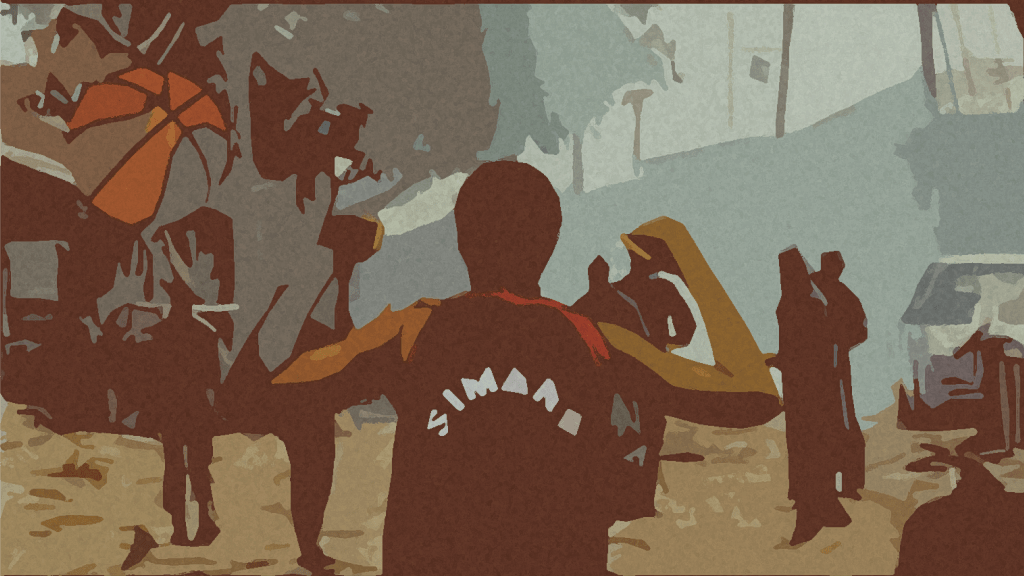
Ten Thousand Francs
Dicho Ilunga Disashi
Background
On April 7, 1994, in Rwanda, members of the Hutu ethnic majority, Interahamwe militia and other extremists began a mass slaughter of the Tutsi minority, as well as some moderate Hutu and Twa, over the course of 100 days.
DENISE RUTINDIKA WASN’T one to sit back, waiting for something to happen. She was the kind of girl who made things happen, no matter the cost. At sixteen, her forthright manner was reflected in her love for dressing up like her favourite movie stars in the films she’d recently seen. I was surprised when this energetic and beautiful girl, who had blatantly accused me of arrogance days before, talked her way past the doorman into the gymnasium where my basketball teammates and I were practising.
I recalled our previous encounter as I saw her enter the building.
“Why are you so full of yourself?” she had said. “You think you’re a big man, a star who can ignore anyone he likes.” It was true; I had pretty much ignored her. However, it wasn’t intentional, and I didn’t feel like a “star.” I was too young for that—barely twenty-one. But I had done well since moving from Zaire to Rwanda. In just two years, I had advanced to a managerial position in the store where I worked. My earnings allowed me to eat well, and perhaps I did seem to parade around “like a proud peacock”—a label she also assigned me that day.
I tried to reason with her. Of course, I couldn’t. I doubt anyone could. Then she left, and I realised how badly I’d behaved only hours after she left.
Apart from my daytime work, I spent my free time training with my basketball team. We called ourselves Virungans. Virunga is a volcano in the eastern Congo close to Uganda. The name seemed appropriate. We played hard. When we had the ball amid a game, we were nearly invincible. Yet, we were more than just a team. We were brothers helping one another succeed in a strange new home. Most of us had recently immigrated to Rwanda from Zaire.
In 1989, at eighteen, I left Goma, a district capital in eastern Congo. I left because of the crippling economic impact of the Mobutu Sese Seko regime. I saw no economic future in Zaire and left to seek work in Rwanda. Many others like me were leaving Zaire for better jobs and a more hopeful life.
Leaving my homeland took work. Travel in the area was primitive. I walked and camped along the roadside for three days, begging for a ride. Finally, I was picked up by two basketball players who recognised me. They not only let me ride with them, but they let me share the room they leased in an apartment near Kigali, the capital of Rwanda.
In the evening after work, the three of us practised basketball out behind the apartment for as long as sufficient light remained. We were good, even as just a trio. Our practice began to attract onlookers, as well as other players.
I have always loved basketball, and it was close to this time that I adopted Michael Jordan’s surname as my first name. Hence, I became known as Jordan Simaro instead of Jackson Simaro. The fans soon noticed this, and the theft of a prominent name seemed to lend strength to my game in some subjective way. We youths did little else in our spare time for eight months, but we practised this way. Our lives seemed in near isolation from the lives of others around us. The team grew, and by the end of this incubation period, we had expanded to twenty-two members. We devoted ourselves to developing teamwork, a cardinal element in this unusual sport.
On weekends, we were allowed to use a large practice hall in a school gymnasium nearby. Here, the twenty-two of us would divide ourselves into well-balanced teams. Our quiet, skilful movements and the incessant thumping of the ball on the hardwood floor continued to attract a steady crowd of onlookers.
A self-confident sixteen-year-old girl was among the crowd one evening. The doorman later told me that as she pushed past him, she said, “Tell Jordan that I’m here.”
DENISE, BY ANY standard, was a young beauty. She stayed about two hours this time, and our eyes met too often. I played badly. As practice ended, she got up and left without saying a word. I remember thinking, what does this strange girl want of me?
My teammates soon warned me that her flirtation could have dangerous consequences. Her father and brothers were huge men whom everybody in the area feared. They were leaders among the Tutsi peoples of Rwanda. I had left my homeland partly to avoid overbearing men like these, and I promised not to pursue her. Unfortunately, or perhaps fortunately, that promise lasted almost no time.
I was cooking myself a late lunch one afternoon when I felt someone’s hand caressing my chest from behind. I grabbed the hand and turned around. Of course, it belonged to Denise.
Day after day, usually on weekends, Denise would find an excuse to visit me where I lived. My people say that life begins when you meet the woman life intended for you and that saying soon proved true for Denise and me. We found ourselves overwhelmed by a love that blossomed far too soon.
One fateful day, Denise’s cousin, the man her family intended her to marry, came looking for her. The clever man wandered onto the property and moved about the apartment, peering into windows. Two lovers failed to hear him as he peeked through their window. We had neglected to draw the blinds.
In only minutes, Denise’s family—father, mother, four brothers, and a sister—gathered at our door. The father led the pack, pounding on the door. He shouted, “Foreigner, my respect! My honour!”
One of the gigantic sons broke into the bedroom.
Neighbours and friends eventually calmed down the dismayed father, pleading with him not to make a spectacle. However, before he left, he launched a fearful threat. “Zairois,” he shouted, “If you do not pay money and marry my daughter, I will kill you. That you must believe!”
From that moment on, Denise began living with me, and during this time, Sandrine was born. Six months and an eight-hundred-dollar dowry later, we were married, and for many months thereafter, she teased me and said, “My father do a good thing. I know you not marry me otherwise.”
“So that was your plan all along? Maybe you told him where to look for you.” I’d tease back.
Denise’s mother, even after we married, used to urge her to have children with Tutsi men instead of with a worthless Zairois man. No doubt, she schemed to bolster the Tutsis’ number with friction between the Tutsi and Hutu already on the rise. Oddly, her mother seemed genuinely serious, which became one of our little private jokes.
In 1992, we bought a new house on a peaceful small lakeshore near Kigali. A year later, our happiness doubled with the birth of beautiful Bijoux; with the joy of a newborn child and melodic sounds from the lake drifting through the open windows of our new home. Life was indeed beautiful.
Denise was a lovely mother. She nursed Bijoux and took exceptional care not only of the children but also of herself. She maintained a strict diet, including bread, vegetables, sweet potatoes, and milk. She wouldn’t touch meat despite her Tutsi heritage. She felt that the vegetarian diet would also be better for our children.
Sometimes, I would stand in the corner, admiring her. She would dress up like her favourite movie stars for some occasions, just as she had done in her adolescence. The clothes transformed her. They charmed everybody around her. Our joys were simple, our bounty sufficient, and our shared years were idyllic.
However, the events that followed brought incalculable change.
ON APRIL 6, 1994, the basketball team stopped playing, and the neighbours bolted their doors. President Juvenal Habyarimana’s plane had been shot down. At first, as I listened to the news, I didn’t know what to think. Then, gradually, as the details began to sink in, I thought, Oh my God, now they’ve really done it. Within hours, prominent members of the government began calling for the death of all Tutsis.
Gangs of Hutu, armed with machetes and clubs and coaxed on by soldiers and government officials, began killing Tutsis by the hundreds. The Rwandan genocide had begun. Everyone of Tutsi heritage was in danger.
Each day brought more deaths than the day before as the news spread like a prairie fire throughout the nation. Hutu and Tutsi neighbours, who had lived side by side for generations, now eyed each other with contempt and suspicion. Neighbourhoods across Rwanda turned into killing fields as army units joined the militias in wiping out the Tutsi problem. There would be no middle ground. The numbers grew at an unbelievable pace.
Inevitably, four soldiers came one day to our front door. They stood with their AK-47s at ready, surveying the living room. “We are looking for the snake,” one said.
I was at home watching my children and the neighbouring kids play a game when the soldiers entered. Again, one shouted, “We are looking for the snake.”
“There is no snake here,” I said. But as I spoke, Denise opened the door to see what was happening, and their leader said, “There she is! There’s the snake!”
They grabbed her and dragged her out the front door. She and I fought them all the way, but they were too strong. With every argument I could muster, I begged them not to hurt her. Our children followed us outside while other kids fled. I hustled my two back into the house and quickly reassured them. When I returned to the scene outside, Denise was on her knees, begging for her life. She had recently befriended a French couple who had left Rwanda and had given her many of their belongings, including a television, a stove, a fridge and a video recorder. I offered them everything in the house, but they just kept saying, almost chanting, “We must kill the snake.”
One of them drew a machete. Another held a heavy club. To my horror, I realised that they intended to butcher her as they were doing to others all over Rwanda. They couldn’t waste bullets on snakes. They had to use knives and clubs. No! More than that! They wanted to use knives and clubs. It’s odd what the human mind does in a crisis. Mine turned to related instances that I had read about. Mobs gone mad with killing seemed to choose to do their evil work up close and personal, hacking off limbs and smashing skulls. There are records in such times of tossing babies in the air and catching them on bayonets or setting churches full of refugees on fire and shooting those who tried to flee—their backs engulfed in flames. While I, in this helpless state, begged, “Please, not like this! If you must kill, then shoot. Please, have mercy?” How could humans harbour such hatred?
I tried one last time to play to their greed. “You want money? How much money?”
They agreed that if I gave them ten thousand Rwanda francs, they would shoot her instead of butchering her. I rushed into the house, grabbed Bijoux, who had returned to the entrance, and into the bedroom where we’d hidden our money, gathering the notes.
I heard a gunshot and rushed back out. When I came out, they were leaving, and Denise was lying in a pool of blood. They did not wait for the money.
For hours, I sat on the ground beside the body of my beloved. Had I done the right thing to goad them into shooting instead of slaughtering? Was there some magical way I could have saved her? Three years ago, she had won my heart by her forthright manner. Perhaps she had angered some government official in Kigali with that same haughty behaviour. But how did it come to this? She was a Tutsi by heritage, but she was married to me, a citizen of Zaire. There was nothing now to be done. The love of my life was dead.
AT THE TIME, nobody was allowed to bury Tutsis without the express permission of the army. Instead, I was required to wrap her body in sheets and await permission. The neighbours would not help with this for fear of bringing the Hutus’ wrath on themselves. I dragged her body to the back of our house, where she would be safe while I waited for authorisation.
When I entered the house, my children were silent and trembling. They had witnessed images through their tear-filled eyes that would remain with them for the rest of their lives. I, too, was trembling. I couldn’t think of what to do to help my babies. I was still inside the house in this numb and near catatonic state when three more militia burst into the living room and found me. I could not bring myself to protest when they made me strip and kneel before them. One pulled out his machete and held it flat against my chest just above my heart as though to take a measure of where to strike a blow to the back of my neck. Bijoux began to scream, and that brought me out of my stupor.
I closed my eyes. God, it is finished. Now I will join Denise. I spoke to the one with the machete as calmly as possible: “All I ask is that you take my children home when this is over.”
At that moment, a friend I knew only as Sylvain burst into the room. He also held an AK-47. He was a leader in the militia and a genuine fan of our basketball team.
Sylvain spoke quickly to the three. An argument over my fate ensued. The one with the machete turned the blade a quarter turn and cut me across the chest. Then they dragged me outside, arguing all the way. Once back on my knees outside, Sylvain and the other three then drew some distance away and cocked their rifles. I caught my breath. Nothing happened for maybe ten seconds. They began to argue again. I glanced up to see that Sylvain held an armed grenade.
“If you kill him,” he said, “none of us will leave this place alive.”
After a tense moment, the three lowered their weapons and backed off.
Before he left, Sylvain quietly warned me that more trouble was coming. That I should flee to the Zaire embassy straight away. My greatest fear lay in Bijoux sharing her mother’s slender build and sharp features, characteristic of the Tutsis. She seemed, in many ways, a miniature of her mother.
“Sylvain,” I said, “they killed my Denise. If only you had come an hour earlier. They will want to kill Bijoux. But if they do, I warn you that I will return and kill every Hutu I can find. I will kill you and all your family. You will all die.”
Sylvain stepped back with a look of indifference. He chalked up my outburst to the ranting of a broken heart. I watched them for a long time until they were out of sight before going inside to pack food and supplies and prepare the children for the trip to the embassy. Thousands of Zairians were fleeing to their embassies, desperate and in chaos. In the madness of what was Rwanda, there seemed to be no respite, no Enough. Outside the embassy, the roads to the border were long and reportedly filled with Hutu predators. Even while temporarily safe in the embassy, we were far from out of trouble.
Elsewhere, scores of people, unable to reach the embassy, were streaming towards the nearest border with only what they could carry. The death toll along the way was enormous. In the fields, dogs fed on the carnage. Rwanda was in flames. Foreigners from every nation were fleeing their embassies in Kigali, desperately seeking to avoid the killing fields around them. Conditions in the embassy were poor. Close to four thousand crowded the gardens outside and the rooms and halls inside. Food was scarce. Thankfully, most had brought food with them. Sanitary facilities were hopelessly inadequate. Many people were ill. Medicine was not available. Some elderly died, and some babies were born.
By pooling resources, groups could hire buses to transport them to the border. The cost was one hundred and fifty thousand francs per trip. I found a group from our basketball team camped out behind the main building. Among ourselves, and with the help of a few others, we raised the money for the trip. More difficult was the requirement that a government official accompany us and that we have a letter from the government of Rwanda stating that we were Zairian refugees entitled to safe passage home. It was nine days before we could leave. We flew a huge flag on the bus as added protection.
All along the route, we were stopped. In a town along the Mwogo River, they made everybody get out of the bus. They lined us up and examined us. They took Bijoux to one side. They ignored my demands that she was my daughter. They saw in her too many Tutsi characteristics to let her pass, and they placed her against a wall pockmarked with bullet holes while they searched for others with similar features. There were no others. The firing squad began loading their weapons.
I hurried to the wall to shield Bijoux with my body. In a moment of incredible self-sacrifice and tremendous risk, a dozen basketball teammates joined me, some even with their wives and children. They refused to leave when the officer in charge accosted them. Unbelievably, the officer relented and allowed us to continue on our journey. We were stopped repeatedly all the way to the Ruzizi border gate.
Zaire was a poor place of refuge at this time. The dictator, Mobutu Sese Seko, headed a government so rife with plundering that the nation’s resources had been depleted to a point where there was little left to pay civil servants, much less military personnel. The country’s economy was in free fall. Prices were surging. Supermarkets sold products in groups rather than individually to minimise losses and keep up with inflation. The value of Zaire was devaluing by the minute.
At the border, we were forced to fend for ourselves. Looting, bribery, and corruption prevailed as the soldiers from Zaire searched through our belongings for valuables to steal. Most of us were too tired and discouraged to complain. On the ride from Rwanda, I had packed the team equipment, a pair of expensive boots stuffed with some of Denise’s jewellery, and a leather jacket. As I opened my bags for inspection, Bijoux and Sandrine were by my side, and one by one, the vultures came to claim their due. A colonel made off with the boots and jewellery, a major took the team jersey, a captain took five basketballs, and a few from the lower ranks picked through the scraps.
I didn’t say a word then, but my anger grew as I left the line. I turned and went back to accost them. Why should I be frightened of my people? I thought. Standing over the pile of my confiscated belongings, I shouted, “I will kill you and your family. I have lost my wife, and this is all I and my babies have to start over with. You will all die.” Then I went outside, sat down and cried.”
Without a word, the soldiers returned my possessions one by one—first the boots and jewellery, then the jerseys, then the basketballs.
From across the border, the full impact of what was happening in Rwanda became even more evident. Vehicles by the thousands crowded the streets of the border towns of Zaire, and their progress was hindered by tens of thousands of refugees on foot, many of them Rwandan citizens who had walked from their homes. Along with their meagre belongings, they brought tales of horror, the scale of which may never be fully known.
Three months after the start of the genocide, the composition of those who were fleeing Rwanda began to change. An angry and well-equipped army of Tutsi refugees and exiles had reinvaded Rwanda and was marching to recapture the capital. Now, the Hutus, fearing retribution from Tutsis, began filling refugee camps all across eastern Zaire. Many of these were the same who had been murdering only days before. Somewhere among them, no doubt, were the four that murdered Denise.
I found it hard to cope with my trauma. For a time, I searched refugee camps in the hope of finding the men who killed Denise. The hunter became the hunted. However, eventually, I ceased this search. I realised that it had to stop somewhere. I had to live on, even if only for the benefit of my children and to honour the memory of their mother.
I began to rebuild my life by working first as a security guard and then as a coordinator for the Red Cross. Ironically, some of my previous training equipped me to help other refugees—even Hutus—irrespective of their probable guilt. I felt that I had to rise above my losses. In my lineage were Hutus, Tutsis, French, and Arabs. If I were to continue to hate the Hutus, I would hate a part of myself.
The genocide in Rwanda was not an incident in isolation. Deep hatreds remain in the border cities on both sides. Bijoux experiences incidents at school almost daily. Born in Rwanda, she is Rwandan in the minds of the Zairian, now Congolese, children.
“Sometimes,” she says, “I am accosted by other kids at school. It makes me feel very bad, and I question my nationality. Where do I belong?”
Once, I asked, “Would you want to leave here when you grow up?”
“It is not a question of when I grow up,” she said. “Even right now, I would like to leave here and find a quiet place where there are not always probing questions.” Her hurt, even now at fourteen, is far too close to the surface.
For a time, our basketball team—those who were left—reunited. The team practised in the evening near our home, communicating in Mashi, Lingala, Swahili and Kinyarwanda for a month or two. But the practice lacked the authenticity it had before. We each had a hurtful story too painful to retell. In some way, our temporary togetherness stemmed from the pain of wounds we feared would never heal.
Dicho Ilunga Disashi is a South African writer living in Durban, South Africa, born and raised in the southern Congolese city of Lubumbashi. Both his parents are originally from the province of Kasai. After surviving the ethnic cleansing in 1990, he fled to South Africa. He is now a widow and single father of two. He is the author of the epic historical novel Dancing with Cannibals, available from Amazon Books.
 lọ́unlọ́un