
There Came a Bottle
Jehu E. Sylas
Background
On July 9, 2000, in Harare, Zimbabwe, police fired tear gas into the crowd during a World Cup qualifier against South Africa, triggering a deadly stampede that killed 12 spectators.
THAT SUNDAY, long before the World Cup qualifying match between Zimbabwe and the South Africans—before Delron Buckley slotted the ball into the back of the net in the 84th minute—Nyasha had gone to church with her son Terrence. It was a small and surprisingly quiet Pentecostal church in Chitungwiza, tucked behind a big supermarket on Chitepo Street, with a close-knit congregation. After the service that day, they all shook hands and hugged one another as they typically would. A sister had been impressed by Nyasha’s hair, said the braids were so neatly done and asked her for the hairdresser’s shop. She complimented Terrence’s black velvet waistcoat, which he was wearing over a white long-sleeved shirt, and asked if she’d gotten it at Avondale Market, her hand resting on the boy’s shoulder. And just like that, Brother Lawson—a young man who was particularly fond of Terrence—approached them with an eagerness brimming in his eyes. He asked Nyasha if he could take the boy to see the game later that day, and she agreed without even pausing to think about it.
It was only later, as Nyasha walked home with Terrence, that she reconsidered her decision. His face had lit up the moment she said yes to Brother Lawson. If there was one thing he loved, it was football. He watched it every chance he got. On Saturday evenings, he played at the small sandy pitch down the street with his mates, their excitement filling the air. He always told her about Pelé or Maradona—how they were the greatest footballers in history—even though Nyasha had never watched them play.
“It’s sad, you know,” he said as they walked. “Zimbabwe has never played in the World Cup, even though we have been trying to qualify for the tournament since 1982.” She didn’t really care about football, but she found that detail quite deep for a seven-year-old. The boy, she always thought, was too smart for his age and knew too much for a child. The day she gave birth to him, he had forced open his eyes moments later, darting them back and forth around the ward to the nurses’ surprise. He never cried and grew up like that, quiet with a heart full of curiosity.
Nyasha was a single parent. Hungwe, her late husband, was a soldier. He had been shot by bandits at the Limpopo border, where he’d been deployed just three months after Terrence was born. She’d felt it in her stomach the day he came to her with the news of his deployment, an uncanny premonition of his untimely death. She pictured him dying there in service, his coffin draped in the country’s flag at the funeral, his comrades offering gun salutes, playing saxophones. He had dismissed her worry when she told him about the bad feeling she had about his deployment and reassured her he would return to them, but his tall, muscular build would never stand before their door again, and she was left to raise the child alone.
It was something she had grown to possess since she was a little girl, a hunch that kept emerging over the years in the deaths that cut across her family tree, so that she’d come to trust it. And now, as she thought about the game, her boy’s soft hand locked in hers, she felt a flush of that familiar foreboding wash over her. And yet, she was unsure because she’d closed her eyes for a moment, and her mind had wandered back to when she was just a young lady, before she married Hungwe—those weekends when he, being a die-hard football fan himself, would take her to see an AFCON qualifier or a friendly match being played in the stadium. It was intense, she remembered, but never dangerous.
When Brother Lawson arrived at their home a little past 2 pm, wearing their country’s yellow home jersey and jean shorts, she did not renege on her earlier agreement; she welcomed him and dressed Terrence up. He came with small flags for Terrence, this boy he’d known since the day she carried him to church, wrapped in a shawl as a baby. Perhaps that was what made Nyasha agree in the first place. Brother Lawson had been fond of Terrence since he was just a baby, and over the years, they’d come to share an inseparable bond. He always brought Terrence gifts, always visited their home to keep him company, always sought him out in church, always did this or that for the boy. If there was one person she could rely on to keep her boy safe, it was Brother Lawson.
She watched them leave—Terrence dressed in a black T-shirt and shorts, grinning as he bade her goodbye, Brother Lawson smiling. If kick-off was for 3 pm, then they should be back home past 5. She lay on the couch and turned on the TV, hoping one of those boring Sunday shows would lull her to sleep. She’d done some laundry earlier, mopped the floor of their one-room apartment, and cleaned the wall clock which had gathered cobwebs, along with the picture frames and standing fan. Then she blended some pepper and tomatoes and prepared fish stew before cooking some rice. It was exhausting, and it didn’t take long before she fell asleep.
Years after he’d passed, she still dreamed about Hungwe, especially on days she felt anxious. He came to her that afternoon, enquiring about the worried look on her face, and she’d been unsure how to respond. She told him it was business—the clothes she sold in her shop at the flea market.
“Sales have been poor lately,” she said to him. She was wrapped in his arms as they lay in bed, the sheets feeling like cotton balls. She sighed. “Some days, not even one person walks into my shop to check out any clothes, Hungwe. Can you imagine that? Not one person throughout the day.” He was quiet for a moment, stroking her hair, thinking of something. It was one of the reasons why she’d fallen in love with him in the first place—he always had a solution for everything that troubled her.
“Here’s what you should do,” he finally said, but just then a strange feeling snuck into her sleep, stirring her awake, only to retreat just as she opened her eyes. She looked at the clock—it was almost 6 pm—and then at the TV, still turned on. That famous Limca advertisement was playing, but as though her eyes knew what she needed to see, they dropped to the bottom of the screen. And there it was, scrolling past on the ticker. BREAKING: World Cup Qualifying Match Between Zimbabwe and South Africa Abandoned After Riot. Nyasha’s mind was still hazy, and it took a moment for her thoughts to settle, her eyes widening in realisation of the one thing that was at stake. She jumped from the couch, grabbed her purse, and hurried out of the house.
Outside, she boarded the first bus she saw. “National Sports Stadium,” she said to the driver, and he said something about how much it would cost to take her there, but it didn’t matter.
“Drive fast, please,” she implored. He sped up, steering the small Peugeot through the busy streets of Harare until they arrived at her destination.
STADIUMS WERE ALWAYS in disarray after big games, but something about the scene was unusual as she walked on the driveway. The air stung her nose and eyes, but she kept walking, searching for Terrence or Brother Lawson.
She felt something unlatch in her chest when she saw a man being carried away by his hands and legs. Then she saw other injured people moaning in pain. Some were sitting, others crouched over, and still others sprawled on the tarmac, writhing like a snake struck with a stick. She kept walking, her heart breaking with each step, with every injury she saw, until a man stopped her some distance from the gate. He had a cut just above his eyebrow, his shirt smeared with dust all over and wrinkled like he’d wrestled with a madman only moments ago.
“Are you looking for someone? There is nobody inside.”
“My son,” she responded immediately. “A small boy, seven years old, about this tall.” She raised her hand just above her waist. “Have you seen him? He should be with a young man in his late twenties.”
The man squinted, shook his head. “I haven’t seen anyone like that. You should go to Parirenyatwa Hospital on Mazowe Street. They took some people there.”
She thanked him and doubled back the way she came, even though the thought of what it really meant heated up her blood. The sun was gone now, and darkness had taken over the expanse of the sky. She hailed a bus going to Mazowe Street.
The hospital’s reception was hot and packed with the victims and their families. Some were crying; others sat silent in their misery. Nyasha manoeuvred her way to the desk to find out if they’d admitted any boy named Terrence or a young man named Lawson.
The nurse looked tired. “We haven’t started asking for their names,” she said. “They brought many people here.” She led Nyasha through the wards, hoping she’d spot her son or the young man she’d talked about. But nobody in the rooms bore any resemblance to any of them. So they proceeded to the open space at the back of the building, which now served as a makeshift ward where more victims were being treated. The victims here were placed on mats and bare mattresses just by the fence of the facility. It was here, at a corner, that she saw Brother Lawson with his thick, unmistakable afro. He was lying on his back, bandaged from his thighs to his feet, a drip attached to his hand.
“Lawson,” she gasped, shocked at what he looked like now, far from the polished brother everybody admired in church. Slowly, he turned to face her, his eyes half-open, his left cheek bruised.
“Where is Terrence?” she asked. He was quiet as he tried to recollect the events. The scenes came to him in slow, hazy flashes. He was standing with Terrence at the stadium’s entrance, the massive oval structure beckoning to them as thousands of fans flocked into it. There was Delron Buckley’s first goal, and Buckley again on the left wing in the dying minutes of the game, receiving that incisive through pass before slotting home past the goalkeeper, giving the South Africans a 2-0 lead.
There came a bottle from the crowd seconds later as Buckley lay on the grass, writhing in pain after colliding with the keeper to score his goal. Many more bottles began flying in like airstrikes, the roar from the crowd rising as the players retreated into the pitch to put some distance between them and their attackers. But the bottles continued, and soon other items joined in the flight: cups, sticks, leftover food, vuvuzelas.
The air was biting his nostrils as the police, in their judgment, began firing teargas canisters into the stands to stop the revolting fans after the referee ended the game with some minutes left to play.
He had gotten up immediately, realising the chaos that was ensuing. “We have to leave now!” he’d said to Terrence, grabbing hold of the boy’s hand and starting up the stairs. But they were in the front row, and with others trying to leave—coughing, choking—a queue had quickly formed all the way up. He had paused for a moment to scan the area for a quick alternative instead of wading through the horde. The only way was through the seats, so he scooped Terrence in his arms and swung away from the jam-packed staircase to the seats, jumping row after row as he clambered up to the corridor, bypassing the crowd.
He had dropped Terrence as he came down the hallway, but the air was the same outside because the police were also firing the tear gas at the exits. There was an ocean of football fans thrown into a stampede, the exit gates packed, people on the fence trying to climb their way out, yelling in English and Shona and Swahili, and tongues he’d never heard before. They were squeezing through the crowd. Suddenly, Terrence’s hand was no longer locked in his. He turned back and spotted the boy forcing his way toward him, and just as he tried squeezing his way back to Terrence, someone bumped into him, sending him to the hot tarmac. He quickly tried to get back on his feet but a leg landed on his back and another leg on his neck, and then … he was here in the hospital in bandages.
He was sedated and too sleepy to show his fear. “I don’t know where he is,” he quietly mumbled to Nyasha. “I was hit, and I must have passed out at the stadium.”
“What?” Nyasha shook her head and turned to the nurse. “Please,” she said. “Are there other hospitals the victims were taken to?”
“I don’t know, Ma,” the nurse replied. She was bent over a woman, adjusting the needle connecting her drip because the vein had begun to swell up, disrupting the inflow of the liquid. “I think you should go to the police station. You will get the information you need there.”
BY THE TIME Nyasha arrived at the police station, her anxiety had travelled up to her throat, and her lips trembled as they uttered the words, “My son is missing.” The duty officer listened as she frantically narrated her story.
“He could be in a hospital somewhere,” he said when she was done, “or with a family friend. You know, over 55,000 people were in attendance.” Then he brought out a file and listed three other hospitals where some victims were reportedly taken: Saint Anne’s Hospital at Avondale, the Harare Central Hospital, and Sally Mugabe at Talbot Road.
She hurried out of the station and barged into each of them, but all she saw were more bruised, bandaged, and sick people—none of them her only child, Terrence. She stood outside the gate of Sally Mugabe after her thorough search, unsure of what to do or what to think. She went back to the duty officer. It seemed like the right thing to do.
“I could not find him,” she said, swallowing hard, her tongue bitter with tears that had dribbled down from her eyes.
“Calm down, madam,” he said. “You are overthinking this. You should go home; he could be waiting for you with the neighbours or a family friend.”
Nyasha took a kombi home, but she didn’t find her son outside. She opened the door, swept her eyes through the sitting room, but there was no sign of Terrence. The TV was still on as she’d left it earlier, showing an evening show that she paid no attention to. She advanced into the bedroom, her legs barrelling through the small corridor, but Terrence wasn’t there. She came out and threw open the bathroom door to her left—still no Terrence. She did the same to the kitchen, the hinges of the door shrieking at her aggression, but the boy wasn’t inside. She turned away but returned immediately, went inside and crouched to check the compartment under the sink, just to be sure. But she found nothing except the L-shaped blue pipe that transported sewage away and the faint, sweet smell of the stew she’d cooked earlier still lingering in the air.
She stormed out and went from house to house in her street, knocking on the doors of her neighbours. It was a small street lined on both sides with bungalows carrying different kinds of apartments.
“Is Terrence here?” she kept asking. “Have you seen my son?” But nobody had the boy in their house, and no one had seen him anywhere that night.
Tired, she stood at a corner in the street and thought of the injured victims she’d seen that evening. She thought of Brother Lawson, the image of his bandaged leg returning to her and his bruised face. The nurse at Parirenyatwa had told her three men were brought in dead and that had further sunk her withered heart down her belly. She tried to imagine this riot that had rattled Harare. The nurse said it was teargas—teargas from the policemen on security duty at the stadium—and that some victims blamed the police’s overreaction on pro-MDC chants from sections of the crowd against President Mugabe. She sighed and cursed them under her breath. What kind of policemen would do such a foolish thing? Her thoughts returned to her boy. He was a smart kid, brave and strong. She recalled the times she caught him climbing over the fence that divided their compound and the cassava farm adjoining the backyard against her approval, the times she watched him walk on it barefoot, hunting lizards like a skilled cat. Surely, scaling over the fence at the stadium shouldn’t be a challenge for his sleek legs. But knowing this only worsened her worry. If he’d managed to escape, then why hadn’t he come home? He knew his way. He could take a bus. She stood there silent for a long moment, absorbed in her anxiety, until a thought sailed into her head. It occurred to her that her son could still be in the stadium, stuck somewhere or even waiting for her. The thrumming in her chest picked up its pace because she found this even more terrifying if it were to be true, and her eyes were tearing up again, her nose running. She moved immediately, taking quick strides to the main road, and as though the universe understood her plight in that moment, a kombi arrived just in time to take her to the stadium.
There was not a soul in sight when she arrived. The facility had the quietness of a graveyard, but she kept walking until she reached the gate and met the security guard there, a lanky man with a cigarette stick hanging from his mouth and oozing the gin he’d gulped a while ago.
“No, I haven’t seen any boy,” he grunted after listening to her story.
“Can I check inside?” she whimpered. “Please. He’s my only child.”
It sounded crazy to him, but he still opened the gate to let her in and was kind enough to hand her a torchlight. And Nysha proceeded at once into the stadium, the torch casting a wide beam ahead. Even in her worry and in the darkness of the night, the walls of the stadium were too grand to go unacknowledged. They towered greatly over her, sending a momentary chill through her veins as she drew nearer.
From outside, the sitting area of the stadium was sectioned off into bays with tall palm trees standing between the staircases leading into the main stands inside. The area was littered with all sorts of items—straws, flags, mufflers, soft drink bottles, biscuit wrappers, and other things passionate fans carried to football games. Above each staircase, huge number tags drooped from the upper deck, labelling the bays.
She entered from Bay 6, climbing up the stairs to the stands. She swung the torch from left to right, then behind her. No trace of her son. She decided to take it row by row, seat by seat, determined to check every corner of the stadium, no matter how long it took. She yelled his name again and again, but her voice only travelled into the night and fizzled out without a response.
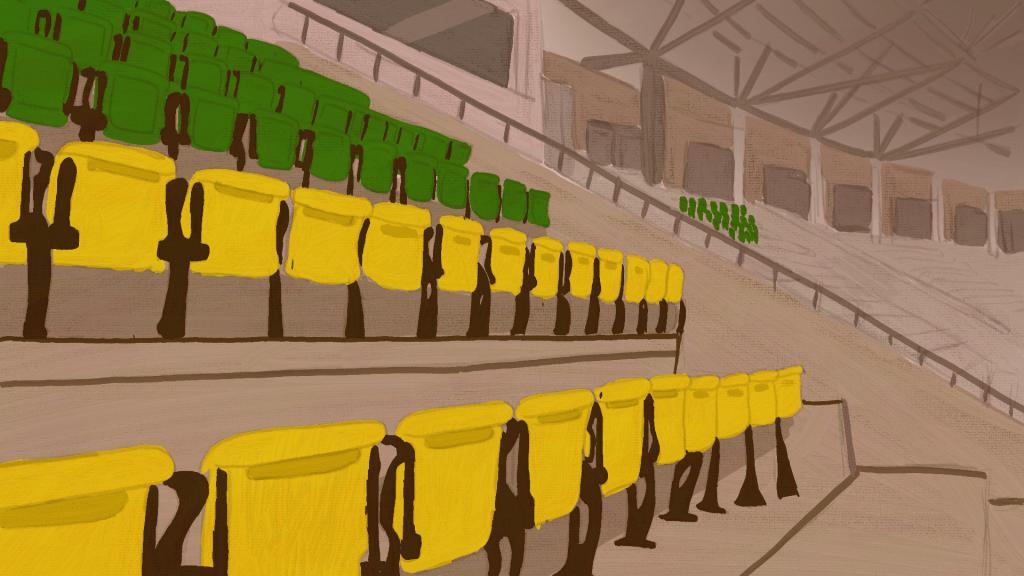
And yet she carried on, moving from bay to bay with determined steps. Some of the chairs were fractured with visible cracks. Some had their backrests completely detached and trampled. There were blood stains also, she noted, smeared on some of the chairs and on the floor, a lurid testament to the chaos that unfolded earlier.
The stadium was indeed a large one, not only for its gigantic walls that curved hundreds of metres from the outside but also for its enormous seating capacity inside, offering at least 60,000 seats—the largest in the country. The Zimbabwean government had designed it not just for football but also in hopes it would host major international track and field tournaments. Nyasha had barely covered a quarter of the seating area before her legs tired out and she decided to sit on one of the chairs to rest her knees and catch her breath, looking ahead across the pitch at the area left to cover. But it didn’t take long before she dozed off right there, her head falling backwards as she succumbed to a deep sleep. She did not dream of Hungwe or anything at all, just enveloped in a peaceful nothingness.
It was almost daybreak when she opened her eyes. The sky had softened into a dull grey, promising an imminent sunrise. Nyasha stood up and rubbed her eyes. The torch was almost drained of its light, but she held it as she continued in her search until the sun appeared in the sky and offered more support. In the end, she managed to go round the full circumference of the stands but still did not find her son. It broke her heart, and she tried to root out from her head the unspeakable things that assailed her mind and continued her search outside, checking all the toilets and corridors and the drainages, and behind the staircases by the palm trees, and behind the flowers, and other spaces a seven-year-old could be squeezed into, but not a trace did she find of her son. She had just checked behind one of the staircases when she raised her head to see the lanky guard standing in front of her, a small bottle of gin lodged in his hand.
“Maybe you should go to the police station. They should have some information,” he said. She saw the wisdom in his suggestion. Surely, they must have found her boy and were waiting for her to come pick him up. She hurried out of the stadium. Outside, people were going about their day, some wearing corporate clothes, some smiling as they traded their goods, chattering warmly, like thousands hadn’t choked on an aggressive gas less than twenty-four hours ago and people hadn’t lost their lives. The duty officer from the night before was handing over to his colleague, preparing to end his shift, when Nyasha rushed into the police station.
“Good morning, officer,” she greeted. “Please, have you found him?”
“Good morning. You are back,” he replied, noting how rough she looked now. Her chocolate skin looked paler than he remembered, and a good portion of her braids that had gleamed just yesterday evening was now covered with dust that she probably wasn’t aware of.
“So far, 12 people have been confirmed dead,” he said, but she wasn’t listening. Her eyes had caught something on the counter—a newspaper dated July 10, 2000, its headline boldly announcing in black ink: Stampede Kills 12 At World Cup Tie In Harare. She grabbed the newspaper and ran her eyes through the article. It spoke of the match, of how it was the first game of the qualifier for the 2002 Korea/Japan FIFA World Cup. It mentioned Buckley being struck by a bottle, said the fans were stoning the police vans, said scores were badly injured, said FIFA had received a report from the Egyptian match commissioner and Zimbabwe would likely face a heavy fine and the National Sports Stadium may be closed for a period, forcing them to play home games elsewhere, maybe in Bulawayo. It mentioned the names of the victims who lost their lives but said nothing about a certain seven-year-old Terrence with skin the colour of freshly brewed coffee and shiny black eyes. She was whimpering now, sniffing, as she skimmed through other stories for any news about a missing child, turning page after page, jumping from headline to headline. But she found nothing. The duty officer could see her anxiety growing.
“Madam, please calm down. It hasn’t even been twenty-four hours,” he pleaded. “Someone might bring him to you at home, and we could also begin an investigation.”
But Nyasha shook her head because, now, she could really feel it in her belly—something had happened to her son. She staggered backwards, her teary eyes in a frozen stare at the duty officer as her vision had now morphed into a morbid picture of her boy lying unconscious somewhere far away.
She fell to her knees and gripped her breasts.
“He is dead. My boy is dead,” she cried.
She was right, but it would take days to know for sure. Days of investigations by the police, answering all sorts of questions, reading newspapers for any news about a missing boy; days of abandoning her shop at the flea market to roam the streets of Harare in search of her son from morning till night only to return home alone to cradle his pictures in bed and weep. Then one morning, uniformed men would knock on her door with solemn faces and ask her to accompany them to the morgue at the Central Hospital to identify the body.
Jehu E. Sylas is a petroleum engineer, writer, and poet. He is mostly interested in works that probe the human condition beyond conventional narratives. When he is not writing, you’d usually find him sleeping, watching football, or immersed in a good book.
Cover credit: Ebumnobichukwu Agu.
 lọ́unlọ́un