
Cheers to doing!
An editorial by Victor Ola-Matthew
Our fourth issue is out! What is next for Lọ́unlọ́un?
Our fourth issue is out, and I have been pondering my seasonal imposter syndrome. We know uncertainty is an inevitable part of building something, yet its presence is almost a surprise every time. Many established individuals and institutions emphasize the process of doing and figuring things out on the go, although they never look as if they started without a long-term plan.
With this preamble, I introduce my uncertainties with Lọ́unlọ́un. I do not know the extent to which the journal can explore; if there’s a zenith (project, image, version, etc.) of the intersection between history, literature, and its sister fields, and how best remembrance can benefit Africa, in this generation and the next. However, when I observe other continent-serving institutions or projects in the humanities navigating similar themes, topics, and goals as Lọ́unlọ́un, I’m glad we’re here. I’m glad we’re doing.
This Christmas marks two years since we began promoting historical literature, particularly fiction. I remember myself in my bed, in my blue bathrobe, with my laptop, an idea, and so much time on my hands. In fact, it was only late last year that I began to recognise the intersections and potential of African historical literature beyond casual reading—which is still good, by the way. Through my research on some period films, I learnt about pedagogy in historical fiction and its ability to either directly inform or evoke emotions or questions that prompt the consumer to research and develop their own opinions. From Immaculata Abba’s revelatory work for Studio Styles’ Sweet Medicine came a conscious understanding of history (the knowledge of it) and other humanities as an essential tool for collective social healing as a nation and continent for the next generation. Finally, in an episode from the second season of The Republic’s podcast on Ken Saro-Wiwa and the Ogoni movement, I stumbled upon Michel-Rolph Truillot’s Silencing the Past, from which I recognise the potential intersections and expansion of historical literature regarding Lọ́unlọ́un, which I am currently dwelling on.
So, what is next for Lọ́unlọ́un?
In the next year, we will be trying something new, expanding beyond fiction into personal essays and memoirs regarding memory and history. I am excited to share and explore that in the coming weeks. However, I return to my original point about the importance of starting and figuring things out as you go, because you will learn along the way whether you have or have not started. Even now, I am uncertain about the plans for next year or the long term for Lọ́unlọ́un, but it’s unfolding as we do. We continue to dance on the hills of funding and grant-seeking to duly compensate contributors, and hopefully, soon, that will be a thing.
Evolution of Home
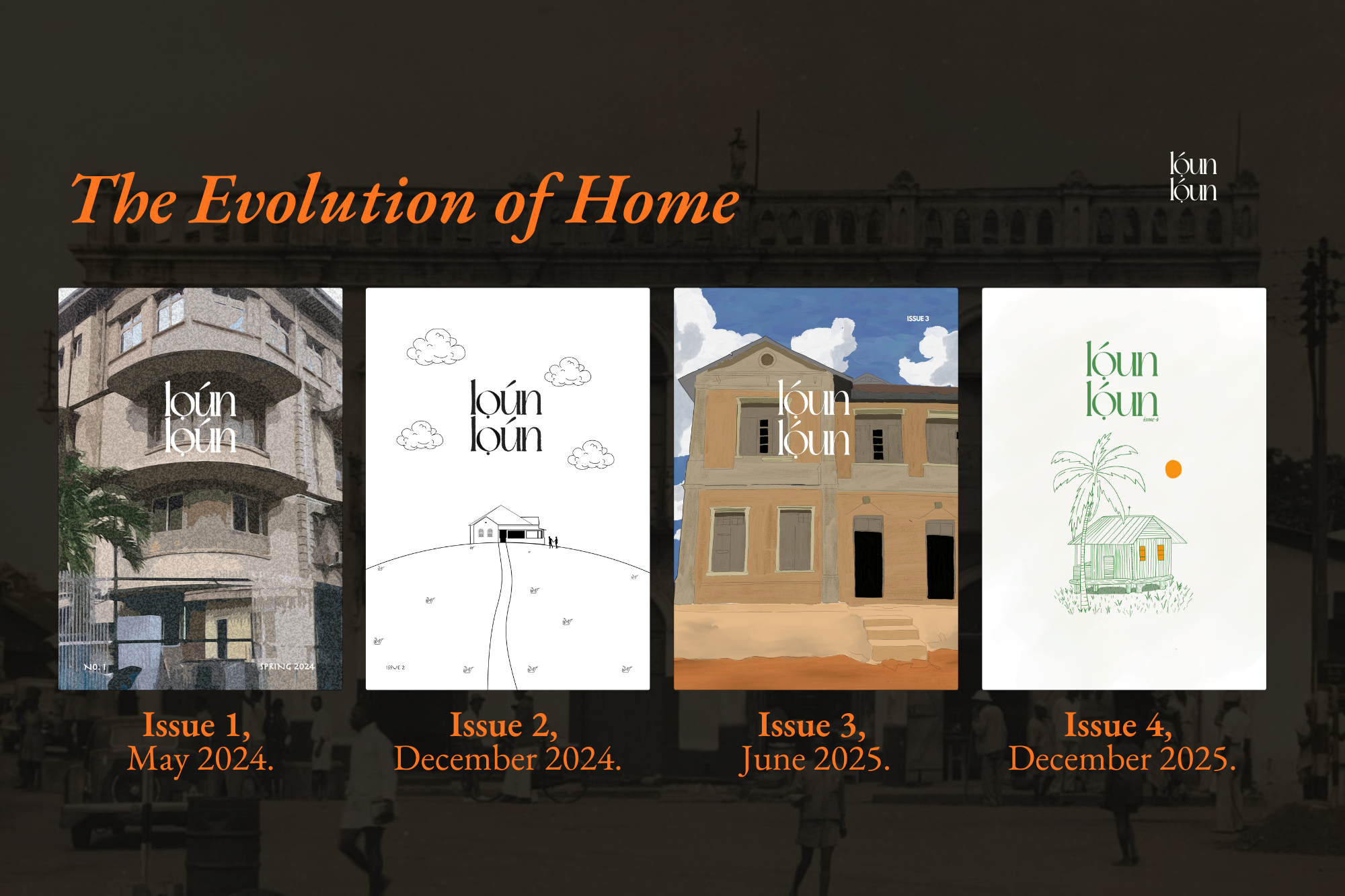
Home is the centre of the covers for each issue.
Should I not have confessed that most of everything has been doing before fully figuring it out, I would have swooned in with a sweet bar on how houses—home, shelter, refuge—became the visual thread running through each cover. I have not much to demystify, but I can say this: the first issue features a residential building along Marina, Lagos, Nigeria, photographed in 2021. It holds enormous sentimental value for me, a quiet reminder of beginnings I didn’t yet know were beginnings.
With Issue 2, the motif sharpened. A lone house sketched across an open landscape with two lovers became our way of speaking about love, longing, and our relative size to the world. By Issue 3, we returned to sentimentality, Ebum’s grandparents’ house, illustrated by himself. And now, Issue 4, Ebum illustrates an abstract interpretation I encountered from the stories featured in this issue.
Issue 4 — Displacement
A recurring theme in this issue is displacement and readjustment — the ways people move or are moved, whether by force or choice, and how those migrations, temporary or permanent, ripple through the lives of the characters shaped by history. We’ve never set strict themes in our calls for submission, yet this has become one of the most unintentionally aligned issues we’ve assembled.
This issue features seven stories set in the Congo, Ghana, Kenya, Nigeria, and Uganda. We will release a story each Monday over the next seven weeks and send corresponding newsletters to our newsletter subscribers, encouraging them to read the stories.
The contributors in this issue include Tomilola Adejumo, Farah Ahamed, Boakye D. Alpha, Sabrina Moella, Joan Namunina, Aby Ola, and Ornguze Nashima Nathaniel.
My immense gratitude to Ebum, Angel and Fortune. Cheers to doing!
Victor Ola-Matthew,
Founding Editor.
 lọ́unlọ́un