
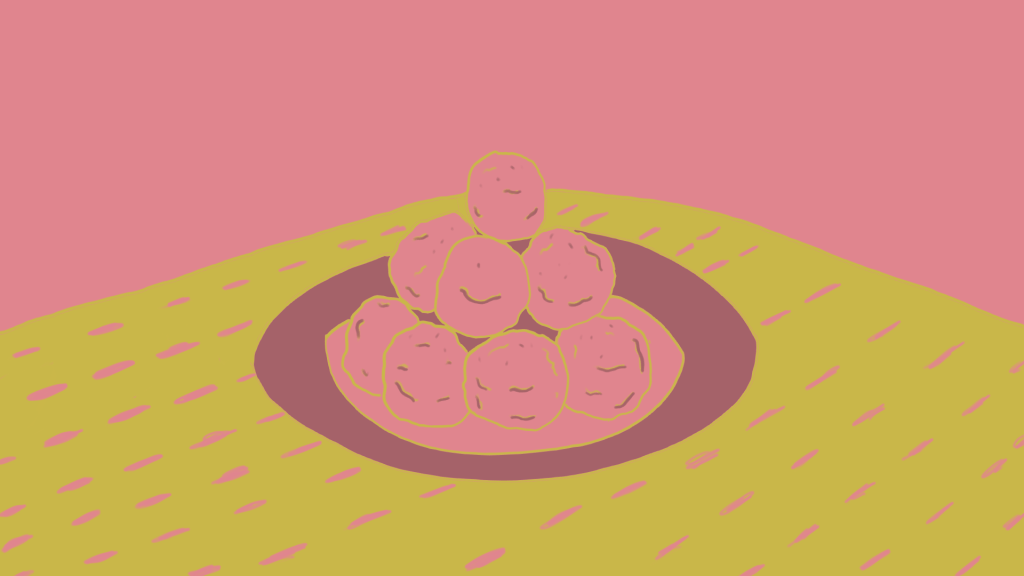
Eating Ladoos During the Coup
Farah Ahamed
Background
On August 1, 1982, junior officers of the Kenya Air Force attempted to overthrow the government. The coup collapsed within hours, leaving over 140 dead and ushering in tighter one-party rule.
1982, Nairobi
“So this is my home for tonight?” She turned in the wheelchair to look at her lawyer, Fabian Pinto.
“Yes, Countess,” he said. “The Sisters reserved a bed for you here, in the Private Wing.”
The room was narrow with only a bed, a tired green armchair and faded orange and red curtains. On one wall was a series of three pale watercolours depicting an uninspiring landscape, on another, a long mirror. She thought of her own room with its fine furnishings, the brocade curtains, embroidered cushions, silk rug and paintings. Never mind, it was only for a day.
“When will you read me the will?”
“As soon as you’re better, Countess,” Fabian said. “First, let’s get you back on your feet again. There’s plenty of time to talk about everything.” He pushed the wheelchair closer to the bed.
“The last thing I needed was spraining my ankle. There’s so much to sort out after that funeral…”
“Yes, but you’re in good hands here.”
“Hospitals make me nervous; the food, the smell, all that cold, medical equipment.” She twisted her pearl necklace around her fingers.
“It won’t be so bad. And, who knows, Countess,” he joked, “you might even get used to the pampering from the nurses?”
“Never. I can’t sleep anywhere except my own bed. I get very anxious.”
Fabian adjusted the brakes on the wheelchair and helped her onto the bed. “I had lunch today with some of my colleagues from the Bar,” he said. “They were talking about the President’s decision to ban all opposition parties. We’re a one-party state now.”
“Kenyan presidents always have something or the other to say, but never anything helpful. But I don’t care about any of that right now,” she said. “I’ve got my own affairs to worry about.”
“It’s a problem because we’re reliant on one man’s goodwill for our security; the President.”
“I know how that feels.” She pushed the flat, hard pillow impatiently. It was not soft and fluffy like she was used to at her home.
“What do you mean?”
She looked at him straight. “I’ve been dependent on the goodwill of one man for the last seventy years, haven’t I?”
Fabian avoided her gaze and fussed with the bedclothes. “The Count always knew best.”
“He didn’t, Fabian, and you know that. He was stubborn and selfish, and I don’t mind telling you now, he could be insufferable; always shouting and going on about wanting to leave a legacy. Seventy years of hell…” She brushed a hand over her cheek. “I’m sorry I’m a burden on you, Fabian. Thank you for all your help.”
“Not at all, Countess. The late Count was not only a client but also a very dear friend, and I promised him I’d look after you. Speaking of which, I noticed you enjoying the ladoos at the luncheon after the funeral. I didn’t know you had a sweet tooth?” He pulled up a chair and sat near the bed.
“The Count was strict. He said they were unnecessary luxuries. Now I eat as many as I want. I’ve even brought a box here.” She opened her handbag and showed him the steel tiffin with the small, bright orange balls garnished with slivered almonds and pistachios. She held them to her nose and inhaled. “My favourite- boondi ladoos. I love the scent of cardamom and saffron.”
He laughed. “What would the Count say to that?”
“It really doesn’t matter now, does it?” She took a set of keys from her purse and gave them to him. “Please keep these safe for me. They’re for the house.”
Fabian put them in his briefcase. “See you tomorrow,” he said.
“Please make sure you bring the will. I must know what it says.”
He adjusted the blanket around her lap. “Don’t worry about that for now; just get better.”
The next morning, a commotion outside her door woke her up.
Running feet, shouting and screaming. She climbed out of bed slowly, placing one foot then the other on the ground. Her ankle was swollen and throbbing. She pulled on the white dressing gown hanging on a hook by the bed, hobbled to the door and opened it.
What kind of madhouse was this? The corridor was strewn with stretchers, with wounded people moaning. Doctors and nurses running in every direction, calling out names and room numbers. “No, no space in ER,””Another ambulance is on its way.”
She stopped a nurse. “What’s going on?”
“Don’t you know? There’s been a coup,” the nurse said. Her uniform was covered in blood stains and the pins had fallen out of her cap.
“What are you talking about?”
“The government’s been overthrown by the Air Force. They announced it on the radio this morning.” She was a tall woman. Her thick arms squeezed into tight sleeves, strong enough to bear anything, but she looked shaken. “Some person called Colonel Odipo from a battalion based at Embakasi is now in charge.”
She leaned against the wall, dizzy. “I want to go home.”
“You’re lucky you’re in here. Outside, everywhere, there’s trouble. People rioting and looting. People getting hurt.”
“Lucky to be trapped in a hospital?” she said. “I need to go home.”
Further down the corridor, more men with stretchers came running in and from beyond, the sound of ambulance sirens.
The nurse pushed the door to the room. “Please go back inside.”
“You should address me as Countess,” she said. “Just because the Count’s gone it doesn’t mean…”
“You need something to calm your nerves. A sedative.”
The sound of gunshots rang through the corridor. The nurse led her inside and shut the door. She clutched the nurse’s hand. “I want to go home.”
“You have to stay here and not panic.”
“I want my lawyer.”
The nurse looked at her with narrowed eyes. “Now, listen to me carefully, Countess, or whoever you are. You might be used to people taking your orders, but this isn’t your husband’s house.” She paused. “We’re in the middle of a coup, so you better cooperate. Do you understand?”
What a stupid, little woman this nurse was. She hadn’t seen life. She was a quarter her age, and now she was standing here bossing her. “How dare you talk to me like that? Do you know who I am?” she said. “My husband, the Count, built this wing. He was the biggest donor to this hospital…” She was interrupted by shouting from the corridor.
“Jesus.” The nurse rushed out of the room, banging the door behind her.
More gunshots. The Countess picked up the telephone on the cabinet; no dial tone. She tried the remote control for the television, no signal. She pressed the buzzer on the side of the cabinet, and the red light above the bed started flashing.
The nurse rushed in, her face shiny with perspiration. “What is it?” She switched off the light.
“The telephone isn’t working, and the television is dead. What kind of room have you given me?”
The nurse wiped her face on her shoulder. “Please, Mama Mzee. Why don’t you understand? Everything’s out of control. The airport tower. The post office. The Central Bank. Everyone has been defeated. We’re in danger. The mob could enter the hospital anytime.”
“I want to speak to my lawyer.”
“Your lawyer? I haven’t even reached my family. I don’t know if they’re safe or my home’s been looted.”
“What about mine?”
“The rioters are burning cars. Smashing windows. Raiding shops. Borders are closed. No one can leave Kenya or come in. The police have been told to act like civilians. We’ve been ordered to stay indoors. Even MPs are hiding in their homes.”
“I’ll take refuge in my home,” she said, getting up. “Just like everyone else.”
“No.” The nurse came closer, her breath smelt dry and acidic. “You’re staying here. And you better behave yourself.”
“Or what?”
The nurse raised her voice, but her tone was measured. “I’ll call security.”
“Don’t threaten me. I’ve had enough of people dictating to me.”
“People are dying. Lord have mercy.” The nurse left the room, slamming the door.
She sat on the edge of the bed and fiddled with the knobs on the phone. What would the Count have said? He’d have told her not to interfere in politics. It was a subject for men with power.
There was a knock on the door and a security guard in a blue uniform and cap came in. A skinny boy, he couldn’t have been more than twenty years old and would’ve fallen on his knees with one push. “What do you want?”
“Security.” He rolled the truncheon in his hands. “I was informed you were causing trouble, and so have been sent to block you from escaping,” he said. “A reporter at KBC was held at gunpoint and told to announce a curfew. No one is going anywhere.”
“You can’t hold me hostage here.” She plucked at the blue and white hospital gown, her hands trembling.
“Aieee, Mama Mzee, stop being difficult,” he said. “Every citizen today is being held against their wishes, even our President. The Air Force has threatened to blow up even the State House. Every home is in danger.”
From the street, the sounds of an uproar; rioters shouting slogans. The guard ran to the window. “Ai, ai, just look at the thugs.”
She limped over to the window. The window overlooked the Limuru Highway, and they could see a mob running down the road, carrying radios and television sets, chairs, pipes, tyres, pots, and pans. Others were lugging suitcases or balancing boxes on their heads. A man was carrying a slab of meat over his shoulder, another a rolled-up carpet. The sky was a deep blue and cloudless. Jacarandas in bloom lined the road on one side. It was funny how one noticed the most mundane and ordinary amid the chaos. Lightheaded, she clutched the curtain to steady herself.
“Those thugs have forgotten they don’t have electricity in their houses.” He made the sign of the cross. “Christ have mercy. Everyone’s a thief today.”
She thought of her own home. Of course it would be safe; they lived in the most secure part of Nairobi. For the first time since his passing, she felt a wave of grief. She moved away from the window and sat down on the armchair. “What’s going to happen now?”
“Mimi sijui, me, I don’t know.” He paced the room. “This my first day doing this job.”
“So you have no experience working in security?”
“No,” he said.
“Go and find a radio, at least we’ll know what’s going on.”
“Pointless. The national anthem is the only thing playing right now.” He covered his face. “God help us. My mother told me not to take this job, in case I got hurt.”
“What’s your name?”
“Kamau.”
From a distance, the sound of ambulance sirens. In the closer vicinity, gunshots and shouting. Kamau bolted from the room.
“Come back, here,” she shouted, “Don’t leave me.” Every person was for themselves. She’d be forgotten.
Kamau reappeared, panting. “People are bleeding, but I’ve got this.” He held up a small transistor. “I took it from the counter.”
“You mean you stole it?”
“There’s a white woman outside in the corridor. A man with a gun raped her in the Hilton hotel room. The police shot him when he was trying to escape. Now the nurses are trying to help her, but she is crying. She says she wants to die.”
She’d never imagined she would see the horror all over again. She’d lived through the Second World War and the days of the Mau Mau Emergency. When would all the violence end? When would people learn? At ninety, she’d seen everything. Even if ordinary people wanted peaceful, simple lives, those in power didn’t let them.
“Lock the door and check the windows.”
He did as she said.
“Push the chair against the door and sit on it. If anyone pushes, push back,” she said. “This could be our last day.”
They sat together listening to the crackling transistor — the anthem on repeat. Ominous, but their only connection with the outside.
She shifted in the bed, her ankle still in pain. She’d received no medication, not even a cup of tea. The room smelt of stale disinfectant. She wrung her hands and raked her hands through her hair. She longed for a handkerchief fragranced with lavender to dab on her temples, a hot bath in her own tub, her own bed with silken sheets, a cup of tea and something sweet. Since the funeral, she’d luxuriated in the solitude of having the house to herself, indulging even in ladoos at midnight, when she felt like it. Remembering the tiffin in her handbag, she asked Kamau to bring it to her. She offered him some. “Ladoos. Indian sweets. Try some.”
“Very good. Did you make them?” He reached for another.
She held out the box of tissues for him to wipe the crumbs off his uniform.
From the corridor, the sound of running feet and shouting continued. From the street, the wailing sirens.
Hours passed. No one came in to check on her. She had been forgotten. Kamau went to the window. “Stay by the door,” she said. “It’s not safe.”
He returned to sitting on the floor, his back against the door. They listened to the national anthem on repeat. At noon, an excited male voice started speaking.
“Sauti ya Kenya. My Dear Countrymen, It is with the greatest pleasure that I announce today the overthrow of the corrupt regime of Daniel Toroitich Arap Moi by the patriotic forces of our country. Our immediate task is to liberate our country once again from the forces of oppression and exploitation in order to restore liberty, dignity and especially justice to the people,” the voice broke up. “Long live Kenya. Long live the People’s Redemption Council.”
Clapping before the anthem started again.
“Turn it off.” She covered her ears.
Kamau fell onto his knees and put his hands together. “Our Father, in heaven…”
“Stop it,” she shouted. “Get up, I can’t bear it.”
“You don’t believe in God?”
“I don’t trust anyone.”
He wiped his brow. “What shall we do then?”
“Nothing. We just wait.”
“How many children do you have?”
“None.”
“Where’s Mzee?”
“He died a few weeks ago.”
“So you’re alone?”
“No, I have my lawyer.” When would she get home? She felt herself dozing. She was in her house, going from room to room searching for something. She opened the drawers in the closet and checked the wardrobe. What was it? She couldn’t remember. In the kitchen, she gazed at the neatly stacked crockery. In the pantry, she stared at the bottles and jars filled with pickles and spices. No, it wasn’t here. In the study, she rummaged in the slim drawers of the Count’s desk, but all she found were old letters and some pens. What was it and where could it have gone? Whatever it was, it was mislaid forever. She collapsed onto her favourite chair and rocked herself back and forth. It was dusk, and the setting sun cast familiar shadows on the living room floor. A crow cawed from the tree just beyond. After her son, Yusuf, had died in that terrible swimming pool accident, it seemed her life had escaped her, gone by, just like that, without her having had any impact on it.
A knocking at the door, Kamau opened it, and the nurse came in with a tray.
“The coup is over.” She set down the tea tray on the cabinet.
“Alleluia,” Kamau said. “We’ve been saved.” He made the sign of the cross. “I knew God would not fail us.”
“Be quiet, Kamau,” she said. “It’s the government, not God, that’s in charge.”
“Harambee Avenue is covered with bodies,” the nurse said. “The President made a statement from the State House in Nakuru; he’s vowed to neutralise all opposition.”
“No one will be left alive,” Kamau said and picked up a cup of tea. “You know what happens at Nyayo House?”
The nurse handed her a cup of tea and she took a sip; it was hot and sweet. The biscuits were dry and stale. She longed to be home with her own comforts.
“The President has launched Operation Maji Machafu,” the nurse said.
“Dirty Water?” she said.
“Yes, Operation Dirty Water. He says he’s going to flush away all the filth from our country. He wants Kenyans to live in a clean environment.”
“Is the curfew over?” Kamau said.
“Not yet,” the nurse said, “but whenever that will be, we’ll need to hold our I.D. cards above our heads when we walk in the streets. If we don’t, the police will detain us at Nyayo House.”
“Aiee, we will never walk the streets again freely,” Kamau said. “Do you have your ID card, Mama Mzee?”
“My lawyer has all my documents,” she said.
“I can arrange a fake one for you,” Kamau said. “My cousin has the machine and stamps.”
“You’d better stop your crooked ways,” the nurse replied, and told Kamau she needed help wiping the corridor floor. They left the room.
She sipped her tea. When would Fabian come? The sounds of ambulance sirens and intermittent hushed conversations came from the corridor. Once she was back in her own home, everything would be all right.
A few hours later, Kamau returned.
“God help us. Our lives belong to the President now.” He looked at her, confused. “It seems even God’s negotiating with the President.”
“I don’t understand,” she said.
“We need a permit to go to Church on Sundays.”
“The President doesn’t control me. I’ll go wherever I want.”
“He’ll decide everything. Where, what, who, and why. The media and VOK are in his control. They’ll report only what he agrees to. Everything must be government-authorised.” He dabbed his brow. “I should’ve listened to my mother and stayed home.”
“If Fabian can’t come to me, then I must go to him. I need my house keys.” She pushed aside the bedclothes.
“I can’t allow it.” Kamau went to the door and stood in front of it. “It’s not safe outside.”
She looked at him for a moment and then reached for her purse. “If you help me, Kamau,” she said, opening her wallet. “I’ll help you.”
“Mama Mzee.” He eyed the notes she’d placed on the bed. “It’s difficult.”
“This should make it easier.” She added a few more notes to the pile.
He pocketed them. “The Bible says we should help those in need. My brother works at a petrol station; he’ll know someone who has a taxi.”
“I must leave the hospital without arousing suspicion.”
“Usi jali. No problem. I’ve friends everywhere. Even the guard at the gate is my cousin.” He paused. “But he’ll need a small incentive not to report your escape.”
She gave him some more cash. “Just don’t mess it up.”
Kamau counted it. “Good. Tomorrow, Lord Jesus will show us the way.” He checked the windows and locked the door. He pushed his chair against the door again and sat down. “We rely on God to deliver us from all evil.” He yawned and stretched his legs. “Could I have one more round, orange sweet thing?”
She handed him the steel tiffin. “It’s called ladoo.”
“You have a kind heart.” He stuffed the sweet in his mouth.
She settled back on the pillows. “I’ll be home soon. Then I’ll eat all the ladoos I want.”
He dusted his hands, switched off the lights.
After a few minutes, from the dark, he said, “You have no one. No family. And no God. Don’t worry, Mama Mzee, you have me. I’ll look after you.”
She did not reply. It wasn’t true. She had Fabian. She had her house. Soon she’d be home. She longed for the scent of her own room and the familiar sounds of her house; the creaks of the floorboards, the dripping taps, and the way the light filled her room on a full moon night. She tried to ignore the smell of disinfectant, but it was not just in the air, but on the bedclothes and on her skin.
In the morning, a shrill ringing pierced the silence of the room. For a moment, she could not register the sound.
“Mama Mzee, simu,” Kamau said, sleepily from his chair. “The phone.”
She picked up the receiver. “Hello?”
“Good morning, Countess,” Fabian said, “are you alright? I’ve been worried about you.”
“I’ve been so frightened, Fabian,” she sobbed. “It’s been terrible.”
“Don’t worry, Countess. I’m coming to see you tomorrow when the curfew is off for two hours.”
She hung up. “My lawyer is coming to take me home.”
“You don’t need my help tomorrow? I’ll keep the money just in case you need it in future.”
She shivered. “Pray to your God that never happens.”
Fabian came the following day in accompanied by the nurse.
“Hello Countess,” he said and kissed her lightly on the cheek.
“I’ve been waiting for you,” she said.
Kamau dragged the chair from the door to the bed. “I looked after Mama Mzee,” he said to Fabian, his expression expectant.
“We didn’t forget her,” the nurse said and patted the Countess’ arm. “We made sure she was alright, and she had Kamau for company the whole time.”
“Surely God was the one who protected us,” Kamau said.
Fabian tipped Kamau and the nurse. “Thank you,” he said. “The countess is very important; make sure you always look after her.” When they’d left the room, he turned to her. “How is your ankle, Countess?”
“Forget about my ankle, I want to go home.” She tried to sit up and felt a twinge in her legs. “Speak to the nurse and get me discharged immediately, Fabian?”
“No one could’ve ever predicted this. Businesses destroyed, people hurt, so many lives changed.”
“Fabian?” the Countess said. “I need my home, I need my things. I need to get out of here.”
Fabian sat down on the chair and wiped his mouth with a handkerchief. He was wearing a grey suit, white shirt, and red tie. His smoothly combed hair shone with pomade, his calm demeanour irritated her.
“I’m desperate to wear my own clothes,” she said. “I hate this gown. Have you brought my house keys, Fabian? I’ll need groceries. Can you help me get a few things?”
He opened his briefcase and took out two packages; one wrapped in brown paper and the other covered in silver foil. “We wanted you to see it before it goes up,” he said, giving her the brown one.
“What is it?” She opened the brown package; inside was a gold plaque with black lettering: The Count Dhalla Private Wing. “What’s this for?”
“In appreciation of the Count’s donation, the hospital trustees have decided to rename this ward in his memory.”
“What else have you there?”
Fabian shuffled his papers. “Next week we’ll prepare the advertisement for sale and contact estate agents for a valuation.”
“For what?”
“The Count wants the house to be sold and the proceeds to be gifted to this hospital.”
“You’re not referring to my house?”
“I’m sorry, Countess.” He placed an envelope on the bed. “The Count’s Last Will and Testament. The Executors will make arrangements for you to live here where you’ll receive proper care. The Count decided this was best.”
She clutched his arm. “No, Fabian.”
“You’ll adjust, Countess. In a few months this place will feel like home.”
She tugged his sleeve. “Help me, Fabian.”
He offered her the package covered in silver foil. It was a container filled with ladoos. “My wife sent these for you. They’re homemade.”
Farah Ahamed‘s writing has been published in Ploughshares, White Review, LA Review of Books, Massachusetts Review, World Literature Today, Markaz Review, amongst others. She is the editor of Period Matters: Menstruation in South Asia, Pan Macmillan India, (2022) (www.periodmattersbook.com), described as ‘an essential book about the female body that dispels misconceptions’ by Book Riot. You can read more of her work at: http://www.farahahamed.com. She is a Kenyan human rights lawyer and lives in London.
Cover credit: Ebumnobichukwu Agu.
 lọ́unlọ́un