
A Detention’s Devastation
Modupeola Oyebolu
Background
From 1993 to 1998, General Sani Abacha’s regime suppressed press freedom by banning publications, closing media outlets, detaining journalists, and enforcing harsh decrees against dissent.
By the time I arrived Tampa, days after the hurricane’s wind and rain had pulled the bay, past its shores, into the streets and, finally, into the houses in my aunt and uncle’s neighbourhood, making them, I imagined, part of the ocean floor for a few hours, most of the heavy lifting was done. Couches, reclining chairs, mattresses, dressers sat outside the house, in the yard in the back, on the lawn in the front.
Throughout the neighbourhood, it was like this: the things that make a home strewn about, a sink at this lawn, books at that one, clothing at another, chairs, tables, wood—once walls, floors, cabinets?—gathered in haphazard piles, the landscape of the place marked by devastation.
I saw its weight in my aunt’s face, too; her eyes, usually eager to notice some nearby delight, were shrouded by worry; their corners drooped, the wrinkles beneath them seemed deeper, and they had a sheen about them, as though she might cry, though she didn’t. Instead, she assigned me a task that evening: photos, hundreds, maybe thousands of them to sort through.
We spent hours on the photos, slowly peeling them apart, willing the ink that had come loose in the flood’s moisture to stay in place. Some came in envelopes, mixed in with papers of varying degrees of importance, a Walmart receipt from 2005, my cousin’s birth certificate, a long-ago scribble of a bank’s address. It was among papers like this that my eye caught the curves of my mom’s handwriting.
It had been years since I’d seen it, I realised: that print that had been such a fixture of my childhood, scattered about the house unremarkably, in the corners of old novels, in pages and pages of notes from her English classes at Ife, in shopping lists written into a jotter gifted at this or that 50th birthday party, or this or that wedding, or this or that retirement.
The sight of it felt precious to me now, a marker of a time before, when the dailiness of our lives as a family meant a kind of proximity and immediacy, a nearness to each other’s things, which was also a nearness to each other’s being. Adulthood had brought a distance that I did not know to prepare for; now our relationship lived in texts, video calls, and visits that began with a fraught day or two as we learned to be near each other again.
My mom had written the note, which was folded into neat squares and held together despite the moisture, in the ‘90s; I knew, because it was mainly a retelling of the court proceedings related to her and my father’s divorce. The thing was suffused with her sadness, the fact of which I took in, not as surprise or new information, but as a knowing, almost as old as me. The contours of her sadness, the particular pitch of her sorrow, felt familiar to me, as much a part of me as the shape of my face, the cadence of my voice, the uneven edges of the birthmark on my forehead.
In the note’s final paragraphs, she’d written, “October 1 is coming, I don’t know what we have to celebrate. Tunji is still in detention.” Here her words felt more universal, like a kind of shared Nigerian inheritance, each of us weighed down by our disappointment over what the country could be, but has repeatedly failed to become.
The earliest contours of that disaffection in me are this detention of her cousin, my Uncle Tunji, in the Abacha years. I was little at the time, just shy of seven when he died, and even I remember the fear that was rampant among adults, a fear that was also my own. I also remember the completeness of the anxiety he inspired, the sense that a darkness was upon the country, that you could not say anything bad about the government, you could never be sure who was listening, who they might tell, and then you too could be taken away. Uncle Tunji’s detention was the centre of this fear, the frightening thing that everyone was trying to avoid; it had happened to him, and to his family.
Growing up with a large family
Our bond was sealed before any of us came to be, Uncle Tunji’s family and mine. His mother and my grandfather—my mother’s father—were siblings, born to a couple in Okeagbe, a town in Ondo state, near the border with Kogi. Their father died when they were young, and my grandfather, who was the oldest the only son, got the upper hand in education. His sister resented the injustice (into her older years, she spoke of being denied a formal western education), but she made a life for herself, trading kola nut, cocoa, garri and yam between Okeagbe and the East, sometimes stopping in Lagos, where she stayed with my grandfather, whom she loved dearly despite the unevenness of their lives.
Uncle Tunji seemed to inherit his mother’s passion for education, though he had a reputation at school. “We had this English teacher who would come to class and would be reading definitions of words to us from the dictionary; but you are supposed to teach us English!!” he said to me on a recent call, his old frustration leaking from him, making me laugh. “So one day, I said, ‘What is this? You’re supposed to teach us English!’ The guy was angry, and then he said I should leave the class. And I said, ‘Why should I leave the class? My mother paid for this class, why should I leave?’ How I developed the boldness, I cannot explain it. But I could stand up, and I was ready to bear the consequences.”
When he lived with my mom’s family in the years between secondary school and moving to the U.S. to attend university, his boldness took the form of a willingness to challenge my grandfather. It was during those years, and after, when he moved back home after a decade in the U.S., that he and my mom grew close. They have always felt more like siblings than cousins to me; my mom has a special fondness for him, that seems in part rooted in admiration for his singlemindedness and a genuine delight in his company. The last time we saw him at a family wedding this year, he spontaneously performed a song while giving closing remarks. Later, he singlehandedly turned a quiet get-together into a comical advice session for the groom. Tunji is funny like that, my mom said when I brought up these memories.
It helped too that they each met and married spouses in the early 80s, and that children arrived in similar order: Funto and Iyiobi, born months apart in ’84; Eyifayo and Moyo, in ’87 and ’88; Titun in ’90, me in ’91; and Iriayo, the youngest of us, in ’94.
My cousins were the delights of my life. I don’t know how they did it exactly, so it feels almost miraculous how much more lively life felt with them. Ordinary days became full of possibility when they were around; happiness unfurled from otherwise dull conversation and play. To this day, I feel a kind of giddy anticipation at the thought of time spent with an Abayomi.
Our families spent a lot of time together in the 90s, on road trips to Okeagbe and in their house in Iju, which felt cavernous and, like its inhabitants, full of possibility.
They came to our flat at the College of Medicine in Idi-Araba, too. I remember one school morning, all of us rushing to make it out on time. Between my mom, my siblings and me, our aunts who raised us, and the four Abayomi kids and their mom, there would have been 12 of us, too many to move quickly through the two bathrooms in the house. The Abayomis were especially stressed that day; my siblings and I went to school nearby, but theirs was further away in Akoka, and they were already running late. “We were always late,” Titun told me, her face worn, as we thought back to that time on a recent video call.
That might have been the morning after they had arrived at their house in Iju late, after they had woven their way through traffic from Idi-Araba, only to find what looked like vehicles from the infamous State Security Service at the gate. Quickly, fearfully, the driver whipped their car around and headed back to us. They made it safely, and, well, there was school the next day, so they got out of their uniforms, washed them, hoped they would be dry by morning, and tried to get whatever sleep they could.
When I first described work on this essay to Titun, I said something like, “I’m interested in how political repression touches families, how they rearrange themselves.” No, “displacement, disorder,” she said, pushing me toward more precise words.
F&T
Auntie Foluke was walking from Ojuelegba to Idi-Araba when a brown Volkswagen pulled up by her side.
“My mind said, ‘Oh, you are in it today,’” she said to me, recalling that day. It was the wiry man she had been avoiding for months. She and Uncle Tunji had met by chance in a banking hall a few months prior, and each time he tried to see her at her residence hall at the nursing school at Lagos University Teaching Hospital, she sent word that she wasn’t available. That wasn’t an option today, so she reluctantly got in his car. He gave her a ride back to campus, and they lingered, talking about all kinds of things. “He was polite, decent, not like many men I had met before. I decided to give him a chance.”
Months in, while at a party for his law school classmate, he left her for a moment to say hello to the host’s parents. He became absorbed in conversation, lost track of time, while Auntie Foluke grew bored, hungry, and anxious about being locked out of her hostel. That night, she ended their relationship.
More than a year later, she was walking on LUTH’s campus when he sped past her in his car, close enough to frighten her. He pulled over to apologize, explaining that he was frantic because his mother was seriously ill. Moved, Auntie Foluke went to visit his mother in the wards. It was his mother who orchestrated their reconciliation, asking to meet Auntie Foluke’s mother, saying she wanted her to marry Uncle Tunji. They eventually married.
But that motif from early in their relationship, Auntie Foluke, waiting, alone, recurs in her retelling of their marriage.
In the early days, his work was the culprit. He’d been advised to create his own chambers rather than work at an established firm, but the hours were long, and money was scarce. “That journey was very rough, to the extent that my mom started bringing us food stuff—garri, elubo, yam—from Ibadan,” Auntie Foluke told me.
Things eventually turned, but he only grew busier.
“I didn’t have a father who was around all the time,” Eyifayo told me. But when Uncle Tunji was home, he was exacting about school work. “If you missed your multiplication, he would beat you,” Eyifayowa said. He occasionally visited his office too, which had become a small but established firm with a few lawyers on staff. “I understood that his work was important. He was something I wanted to be.”
Uncle Tunji had long been interested in politics and public affairs, and, because of his profession, he came to work on a number of human rights cases. He eventually established Human Rights Africa and set up its offices in Ota, where rent was cheap compared to Lagos. It was around this time that he became a lawyer to former President Obasanjo, who was by then a retired general and former military head of state. One of the lawyers in his chambers learned from a peer that Obasanjo needed a lawyer for a matter: Obasanjo had been pulled over at a police checkpoint and, offended by the audacity of the officer, had him beaten by his orderlies. A human rights case had been brought against him by Chief Gani Fawehinmi.
Wait, Obasanjo’s actions were illegal, no? I asked as Uncle Tunji shared the details. Yes, he said. Wasn’t there a contradiction then, in representing him in this case? Well, no, not on the letter of the law, he said.
It was inappropriate to frame it as a human rights matter because Obasanjo was not acting as an official of the state. It should have been brought as a civil case. I respect Uncle Tunji’s intellectual manoeuvre, but can’t help thinking about Inspector Ale, the officer at the centre of the case, who never got recourse.
Moreover, that impulse toward a kind of literalism makes Uncle Tunji likely to ruffle some feathers everywhere he goes. “In the human rights movement, many activists thought Tunji was a lone ranger, an eccentric, a difficult person to deal with, a tireless debater who gave no ground, and somebody who would stand alone on any issue if need be,” Abdul Oroh, a veteran journalist, who was detained alongside Uncle Tunji wrote in his recent memoir on the struggle for democracy in Nigeria, humorously named, Demonstration of Craze.
Uncle Tunji was not helped by the fact that Obasanjo was not a popular figure in the human rights community. Yes, he had peacefully and quickly transferred power to a civilian government when he found himself as head of state in the 70s. But, as this case with Inspector Ale illustrated, he still had the excesses of a military man.
In the chaos of the Abacha era, however, new allegiances formed.
Junta to Junta
There were many military dictators before Abacha—Decree No. 2 under which Uncle Tunji and others were held was made law under Buhari’s regime in the 80s—but his regime’s cruelty, the violent lengths to which it went to clamp down on its opposition, real and perceived, was unlike others.
Abacha came to power on the heels of the annulled June 12, 1993 election, an election that Nigerians had agitated for over the eight-year rule of Ibrahim Babangida. Across the country, people had come out to vote for Moshood Abiola, the wealthy businessman who had galvanised energy around a campaign message of hope, with the tagline “Farewell to Poverty.”
Nigerians had waited for a return to democracy for nearly a decade through military rule at that point, and there was forceful pushback against the annulment. Civil society organisations organised multiple protests. A strike by NUPENG, the union representing petroleum workers, brought the economy to a halt.
Initially appointed as Chief Security Officer of the transitional government, Abacha seized power in November of that year, laser-focused on crushing this public will.
“A reign of terror, impunity, and ‘anything goes’ had enveloped the nation,” Abdul Oroh writes of the Abacha years in Demonstration of Craze.
Abiola was arrested in 1994 for declaring himself the winner of the election. Politicians and activists were being rounded up. Many of them fled the country through Benin Republic with the support of the National Democratic Coalition (NADECO), a coalition of organisations that formed to advocate for the legitimacy of the annulled elections. Alfred Rewane, the businessman who provided much of its funding, was assassinated in 1995. Kudirat, Abiola’s wife, who was also an advocate for her husband’s release and the reinstatement of the results, would be assassinated in 1996.
Then there was the “phantom coup” plot.
Enemies of the State
It was well known that military juntas used coup accusations to neutralise their opposition. Abacha rounded up a disparate cross-section of his opposition, accusing them of orchestrating or serving as accessories to a coup plot, including Obasanjo, Shehu Yar’Adua, who was Obasanjo’s deputy when he was military head of state, Beko Ransome Kuti, of the Campaign for Democracy, and Chris Anyanwu, a renowned journalist. They were tried and found guilty by secret military tribunals. Many were sentenced to decades in prison, and others to death.
At a press conference following the trials, Uncle Tunji called for the release of Obasanjo and others: “If critical comments against General Abacha’s regime can be maliciously catapulted into a coup d’etat and citizens can be subjected to ultimate jeopardy, all Nigerians become immediately unsafe under the present regime,” he said.
Forty minutes into the press conference, eight armed men arrived, forced all attendees into a small room, seized cameras, notes, press releases, recorders, and demanded that Uncle Tunji and two journalists accompany them to the SSS offices. The two journalists were released, and as they left, he pressed a note into one of their hands. “Dear Foluke,” it read:
In case I am not home tonight
I am at SSS offices at the Toll Gate. Now, you should have no worries AT ALL as I am completely in control of myself and clearly not subdued. I emphasise this to you ….
Assure the children.
Word of the detention came to the family in fragments. “I remember so much fear and anxiety,” Iyiobi tells me. The oldest of the children, he was 11 when his dad was detained, just old enough to have a sense of responsibility, and to understand that a person can act on the world, bend it to their will, yet still too young to do so himself. Perhaps, because of the impossibility of this position, he seems to remember the family’s life during the Abacha years with the greatest specificity.
He tells me about the first few hours after his dad was detained, the confusion that ensued, because information about where he had been taken was sparse. Then a rumour about a detention centre, somewhere in Ikoyi. There, he and his mom meet gruff officers, who send them off, saying there was no one by the name of Tunji Abayomi there. “People warned her to keep going back; if she stopped going, we may never have heard from him again.”
This was the character of detention under Decree 2; everything was shrouded in mystery, hearsay and partial information ruled the day, making it difficult to distinguish between fact and fiction, and creating a kind of psychological torture.
For the length of the detention, the SSS prevented each detainee from seeing their loved ones. For Abdul Oroh, this also meant missing the birth and naming of his second child, a girl he named Itsema Raheemat.
Only Iyiobi saw his dad once: seizing a moment when there was no guard nearby, he ran toward the window of his cell at the detention centre and spoke to his father briefly. “Here was my 11-year-old son, clearly scared, holding his chest, yet determined to talk to me,” Uncle Tunji wrote in his journal that night.
Food became the language of Uncle Tunji and Auntie Foluke’s relationship during detention. Each day, Auntie Foluke got up, got the children ready for school in Akoka and went to work her nursing job at LUTH.
After, she went to Auntie Temilola, another cousin of Uncle Tunji’s, to put a dinnertime meal together, often some fruit, a swallow, and a soup. (Oseme Oroh, the wife of Abdul Oroh, covered their morning meal.)
Sometimes Auntie Foluke wrote notes on small scraps of paper, wrapped them in plastic, and included updates on the children and the family, as well as desperate notes about not knowing where to find money for school fees. I have a vague memory of one time, seeing Auntie Foluke by the kitchen counter in our flat in LUTH, silhouetted by late afternoon light, concern lining her face. Someone nearby must have said, they couldn’t bring Uncle Tunji his food because I don’t have a memory of her saying it, but I do remember being plagued by the thought of Uncle Tunji’s hunger, the idea that he would have to go who knows how long without food.
This was probably when one of Auntie Foluke’s notes was found by a guard, and their meal arrangement was temporarily halted. Inside, Uncle Tunji, Abdul Oroh, and Chima Ubani organised themselves, putting pressure on the administration, insisting that the absurdity of their situation necessitated the secret passing of notes. It worked. It was a relief to get to bring food again, I imagine, to feel like, at least that was one thing they could do to sustain a loved one.
I only learned from my interviews with them that Auntie Foluke and the children were themselves barely getting by. Her sole income was not enough to cover food and school fees. “I once sent Iyiobi to a neighbour who had a party, to see if they had left overs they could share,” she told me. Family and her church, Deeper Life, helped, but the situation, the long days, and the illogic of the detention all wore on her.
“Mommy lost so much weight,” Iyiobi said.
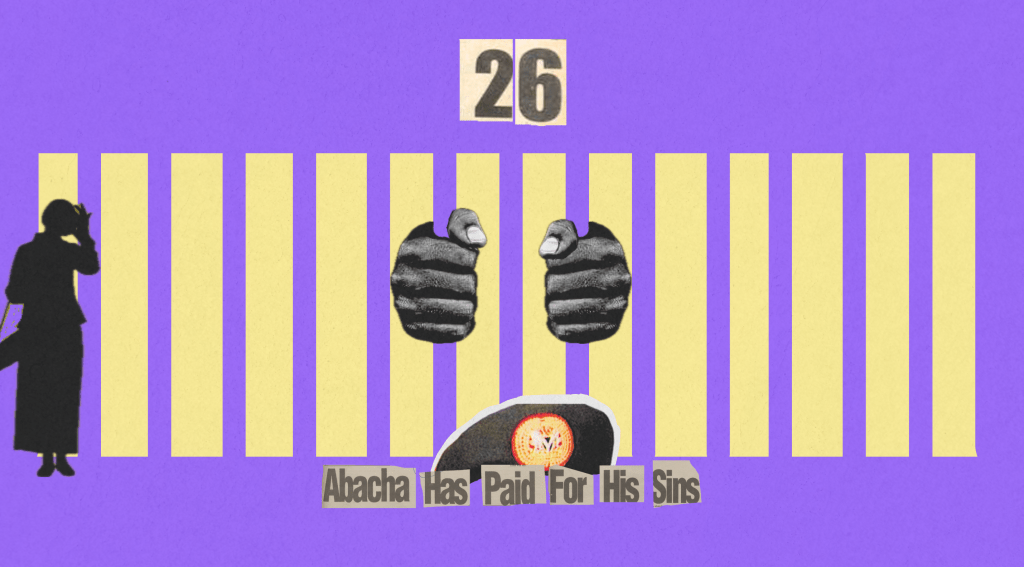
“Detention is terrible,” Uncle Tunji says. A silence passes between us, brief, laden with what is unsaid. In his journals, written on scraps of paper he collected while imprisoned and assembled into a book entitled Cell 26, there are bouts of despair and moments of indignation.
On December 6, 1995, he wrote, “In detention, the emotional spiritual weariness foisted by the restraints is often much more grievous than the physical weariness. Sometimes, like today, I feel somewhat depressed by my helplessness. Why should any human being, for any reason, simply just arrest me and store me away?”
In the pages, too, is the voice of a man who longs for his family.
From December 19: “I rose up, held the pictures of my children. I have seen these pictures many many times but now I make a study of them. As I study the leadership and courage of my first son, Iyiobi, the strength and vision of my second son, Eyinfunayowa, the beauty and tenacious confidence of my daughter, Iyintitun and the explorative curiosity of the last one, Iriayo, an accidental joy came over me briefly.”
Somehow, Uncle Tunji became obsessed with the notion, after October 1—the same October 1 my mom wrote about in that note—passed with no release, that he would go home for Christmas. It’s not hard to see why. There was no recognisable logic to the detention, no case to answer. Perhaps some largesse would touch the heart of the dictator or his cronies, he seemed to think, and they would free him and his co-detainees. It was the season of celebration after all.
This did not happen. Instead, January arrived without change. The detention wore on for months after—his journals trail off here, his papers got lost in the time after—and then, one day in July 1996, 11 months after he was first detained, he was released. No explanation given.
I wish I could say this was the end, that Uncle Tunji went home and was free from then. Alas, it is not. Miraculously, his courage did not flag despite his experience. Instead, he became, maybe even more, dogged about his opposition to military rule, so he remained a target. He was detained two more times, shorter detentions of a few days each, but frightening too, in their own right.
The family too, continued to live in upheaval. One evening, they came home, and “there was a fracas in the neighbourhood,” Eyifayowa told me. It turned out there had been an unusual robbery. The story goes that the thieves asked a child on the street to point out the home of “Doctor.” The child pointed to the home of a medical doctor, which they entered. They shot the man and left. Neighbours were sure that Uncle Tunji, who used the honorific “doctor” because his law degree, earned in the U.S., was a “Juris Doctor”, was the real target.
Every member of the family I spoke to, Titun, Iyiobi, Eyifayo, Auntie Foluke, Uncle Tunji himself, retells the story with a palpable terror. They drove into the compound in a panic, but, too frightened to enter the main house because the “thieves” might return, they hid in the back of the compound, in an outdoor shed. All the lights stayed off, so it would appear that no one was home. Eyifayo remembers peeing on himself. Iyiobi remembers his dad jumping over the fence and walking for a long time, first to a police station, then to a relative’s home.
After this incident, the family left Iju altogether—it was too dangerous, and it was too clearly known to the SSS. They moved to a house in Ota, the town where it all began. Or maybe, we can say it began in Abuja, from where Abacha held tightly to every tentacle of state power. Or in Dodan Barracks, where young men had seized power, coup after coup, for 30 years. Or in Okeagbe’s classrooms, where Uncle Tunji’s dogged will first showed itself.
It didn’t end until Abacha’s death, swift, sudden, on June 8, 1998.
Everyone who was around in the 90s has a story of that day, the spontaneous outpouring of joy on the street, parties, complete with rice and Coke and Fanta, randomly kicking off throughout neighbourhoods in Lagos. “Abacha has paid for his sins: Nigerians jubilate over Abacha’s death,” read the headlines on PM News the next day. And yet, one wonders, do these things ever end so simply?
“You never know how things impact you,” Eyifayo said to me. Iyiobi refuses to speak publicly about politics. Speaking of that time, he and Titun each said to me separately, “I wouldn’t wish it on my enemy.”
Modupeola Oyebolu is a Nigerian writer who lives in New York.
Cover credit: Victor Ola-Matthew.
 lọ́unlọ́un