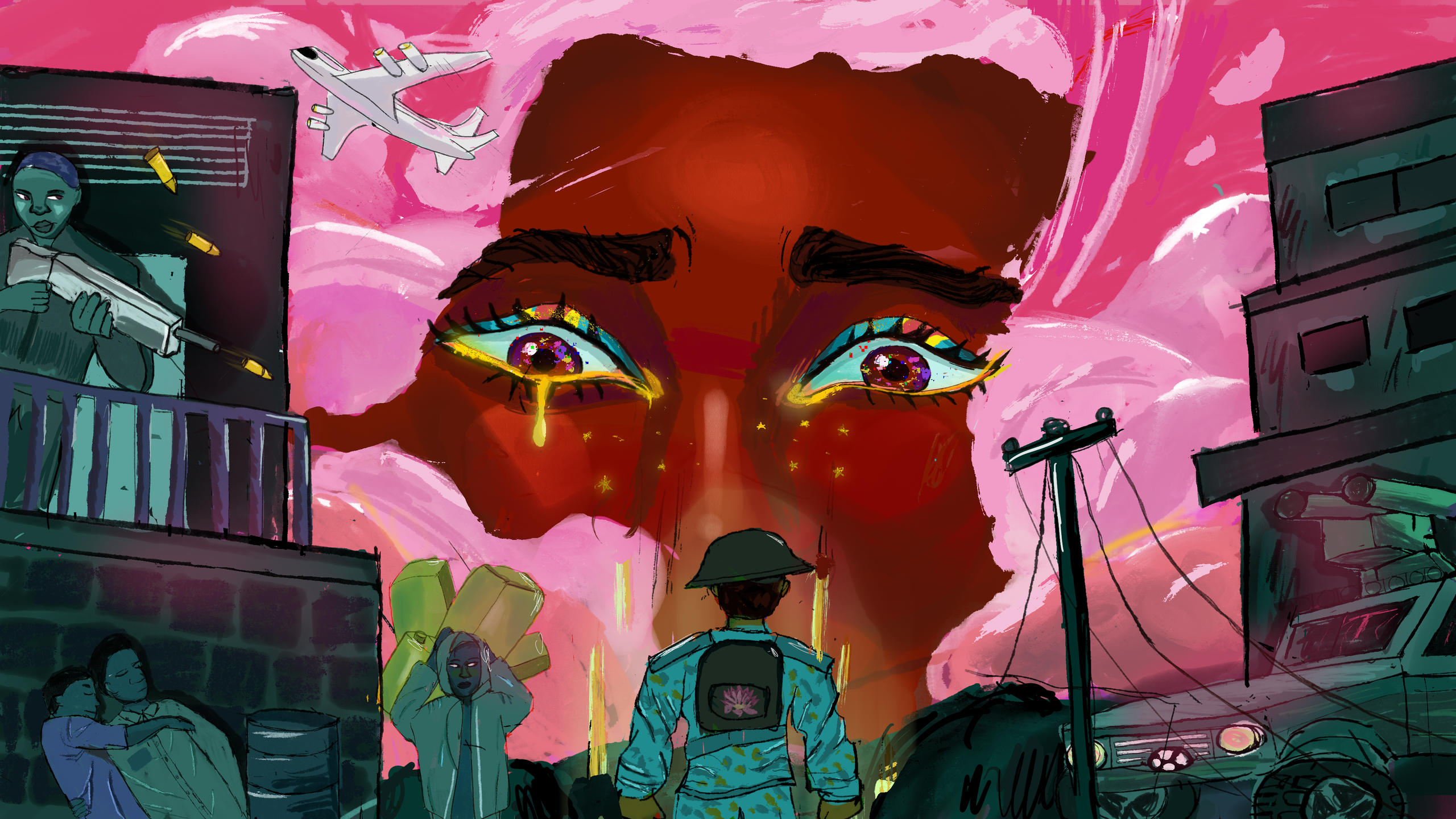
God Mercy
Laurène Southe
Background
From January 23 to January 30, 2025, the M23 rebel group, backed by Rwanda, launched a military operation in the Kivu region in the Democratic Republic of the Congo, resulting in nearly 3,000 people killed.
My cousin’s name is Dieu Merci, which translates to God, thank you, or Thank God in English, but I’ve always referred to him as God Mercy. I believe God put him on earth for a special duty: to break the spell of death. He is the lotus that grew out of mud. We were brought up together in a blended family and grew up like siblings through phone calls and computer screens, always in proximity to each other. When I confided in him about my sexuality, he mourned my old self with me. When I planned to publish my debut poetry collection, he bled the ink for me. The thought of him ever having to fight for his life never crossed my mind.
During one of the hardest periods of my life, Dieu Merci was there for me in ways our family lacked the words to convey. We connected through the unexpected loss of our relatives and how their deaths reshaped our lives. Ironically, the very same experiences that once brought us together eventually drove us apart, and we would spend the following years without contact. When we found our way back to each other, I learned that Dieu Merci had made a life for himself in Goma. A familiar terror ran down my spine.
Goma, when he spoke about it, sounded far more peaceful than the actual three-headed beast it had come to symbolise throughout my childhood. Growing up in a Congolese household with parents both from Eastern Congo, Goma was the no-go zone, the danger zone, the town you went to but never returned. I learned early on that to be Congolese was to live two separate lives: one in which you roamed the earth in exile, and another where you mourned the dead in your absence. There was no prize to be won in the comfort of a foreign land when you must make peace with death on the opposite side of the world. My father learned this lesson. I still picture him sitting on the edge of his bed, tears falling from his eyes after learning his brother had just passed away, following years of battling his demons at the bottom of a bottle of beer. This was the only time I ever saw my father cry.
Attack on Goma
On January 2, 2025, I chose not to celebrate my birthday. As Prince once said, you’re only born once, and I had long since come to terms with my second life, one in which January 2 no longer marked my birth, but instead recalled the day Colonel Mamadou Ndala was killed in an ambush. Despite the weight of that etched memory, our spirits were full of hope, and we looked forward to a promising year. It must have been a few days later that my family back home and I, God Mercy included, gathered for a meeting to discuss our goals, our dreams, and the future we planned to build for ourselves.
On January 24th 2025, we woke up to the news that M23 rebels had killed the governor of Goma, closing in from Sake; death spread its wings over its first victim. The air thickened again, my chest tightened, but God Mercy tried to reassure me that he could leave the city should the attacks intensify. If we were both honest with ourselves, all of the signs were already there. First, the abandoned tanks from the Congolese army were trailing through the streets just outside of my cousin’s apartment. We cracked jokes to lighten the mood and spoke about how the book launch could show the beauty of Congo instead of its blood, and death laughed quietly in a corner.
The next day, God Mercy called me, gunshots blasting through the phone. God, that awful sound. We both began to panic. The noise was unbearable, microscopic as it may have appeared in my little apartment, far away in Europe. Cancelled flights fell one by one like flies in the heatwave. A power outage meant God Mercy could only call me when necessary. I left messages to anyone, anybody who could shelter my cousin for a night or two, but nobody replied. They were in their own wrestle for survival.
By the morning, Goma had once again claimed its cursed name. I held God Mercy’s last message close to my chest: the gunshots struck so hard he couldn’t hear himself think. They blazed through the ring of the night, just like its trapped citizens, who knew no rest. And then, the silence. A silence so loud that my heart began skipping beats. After a short launch meeting with partners, I collapsed in the middle of the street and let out a scream, tears running down my face. My family back home tried to reassure me that God Mercy was strong, that he had been through many obstacles before, and that he would overcome.
There is a chant with just a few lines sung by citizens turned into overnight soldiers
It goes: “My mother gave birth to me / I was born to die.”
But, their hymn can only be heard by birds as it crosses
the battlefield and makes its way to the heavens.
—excerpt from Silent Genocide
The numbers popping up on my screen were no longer mere body counts I had become familiar with so many times before; now, any one of them could be God Mercy. A week of full silence felt like an eternity. No message, no calls, no sign of life. My double lives now intertwined as death remained near. Although I had encountered death in the past, its presence felt different. It kept me restless, dissociated from the world, numb, and angry at myself. Perhaps I had now arrived at the final stage: helplessness.
In Vienna, we marched in protest against the killings taking place in Eastern Congo, but it seemed only the birds could hear us. “And what is this supposed to do?” One of my cousins replied to my Instagram story of Austrians marching on the street holding a Congolese flag in the air. In that thread of helplessness, I found myself asking the same question: If we, the Occident, were the ones who led the innocent to their deaths, to whom would a cry for help be directed? To whom were we peacefully marching if we were the ones arming the rebels? A difference in interest.
From Kinshasa to Kisangani, I watched as videos flooded social media, showing bareheaded Congolese running through the streets, marching to a different rhythm. Students, street vendors, merchants, all demanding that the government give them weapons so they could help their brothers and sisters in Eastern Congo. In the same breath, my cousin, with the previous remarks, messaged me to say that he had finally had enough. He must feed his rage, and he was going to join the Congolese army to put an end to our suffering. I argued against it; it was the same army the government had underfunded and left at the mercy of well-equipped rebel groups.
However, did I have the right to end his unrest? Yet again, I am reminded of the different perceptions of reality, the walls of privilege that separate our worlds, the difference between mourning contained by structure versus the mourning slowly transforming into bubbling anger amid chaos, and the intricate dance I perform as the child of once-immigrant parents, moving between them.
God Mercy survived, barely, but Goma did not survive him. Dead bodies lined the streets, ghosts ran in and out of houses, and after a week in hiding, he crossed the border into Rwanda for his first meal and some money. Nearly 3,000 Congolese people were killed in one week as the city fell under the control of the rebels. God Mercy, by the mercy of God, was not one of them.
God, mercy us, mercy me
Mercy our hour, our return to dust,
and grant our souls your eternity.
Wherever mercy may go,
turn the rubble beneath his feet into rose petals.
The streets of Goma may call for his name;
let your mercy upon us be their answer.
For the righteous of them all,
Mercy walks amongst them.
To the lioness of our hearts,
we laid down our claws in your honour.
God, mercy us, mercy me
Mercy our hour, our return to dust,
and grant our souls your eternity.
L.S.
Laurène Southe (b. 2000) is a writer based in Austria of Congolese heritage. Laurène used to attend the Vienna African Writers Club led by the African Studies of the University of Vienna. After a performance at the African Diaspora festival in Klagenfurt, she began taking her practice professionally. In 2022, Laurène took part in a group exhibition titled An Der Schönen Blauen Donau. During the Vienna Design Week in 2023, she performed her second group exhibition, A House is Not a Home. Laurène attended a writer residency at Echo Correspondence until the end of 2023, during which she completed her first full-length poetry collection titled Child of Congo. She has been published by Brittle Paper, The Shallow Tales Review, and the African Migration Report Poetry Anthology. As of late, Laurène exhibited in Graz at the Forum Stadtpark for Space & Time: the Dynamics of Extractivism, and was a guest author at the 48th Solothurn Literature Festival. She self-published her debut chapbook, Bullet Fragments from a Child of Congo, and is a co-founder of the first contemporary Congolese poetry anthology, set to release this year.
Cover credit: Ravanjie