Unshackled
mwĩhaki k.m
Background
In 1952, the British colonial government instituted a state of emergency to thwart the activities of the Kenya Land and Freedom Army, popularly known as the Mau Mau. There was an expansion of the detention system and a prevalence of mass arrests, abuse and forced villagisation during this period.
M’Mwenda shifted his weight onto his cane to lessen his discomfort. At barely fifty, he had become accustomed to the shuffle that made him seem several decades older. He suspected that the excessive throbbing in his lower left leg was a psychosomatic reaction to the airport grounds. His female relatives fussed about noisily, embracing busyness as a defence against the inevitable goodbyes. It wasn’t working. Emotion enveloped the women in colourful shukas as they milled around Gakenia and her two suitcases.
The terminal bustled with families congregating around loved ones, loud prayers and weeping sounds reverberating. Porters worked valiantly to shepherd tourists, still decked out in khaki safari gear and outdated pith helmets, towards the check-in counters. From her new handbag, Gakenia drew out her ticket and dark blue British passport, stamped with its royal coat of arms and St Edward’s crown. At the bottom of the cover was the qualifier: Colony and Protectorate of Kenya. M’Mwenda gave the small hardcover book a cursory glance, his spirit recoiling at its unspoken inference. A pass by any name is still a pass, whether a kipande or a passport. The yoke of any identifying document issued by the colonial government was an ever-present reminder of station in the protectorate.
Briefly, he contemplated how his daughter would return to Kenya after she graduated. Just a few months earlier, internal self-rule had been declared, and the colony now waited with collective bated breath for full independence. Tanganyika and Uganda had already achieved theirs the year before, but M’Mwenda thought it was foolish to rely on promises until they were fulfilled. With an excited smile, the budding university student asked her brother to carry her luggage to the check-in counters. Wailing from the womenfolk began but died quickly when she promised to return once the formalities were complete.
As excited as he was for his daughter when she was selected for the Mboya-Kennedy airlifts, sponsoring bright students to America for university studies, M’Mwenda knew that coming back to this place would be difficult. His whole body knew it; that’s why the pain in his leg was so intense. It carried memory within. Time had done nothing to release him from the horror of its grip.
He shuffled over to a chair and slowly eased himself into it as he recalled his first encounter with aeroplanes. Though over forty years ago, the memory remained vivid. He had been busy trying to move his father’s goats away from a millet field. From experience, he knew that if even one goat got close to the grains, his whole morning would become a tireless exercise trying to extricate the herd from the sweet-tasting stalks. He was so fixated on corralling the goats that he didn’t notice the rumbling noise from the sky until it was almost upon him. When he looked up, he was enthralled. Above him was a machine making its way through the clouds, descending as its wings dipped, then straightened. Frightened by the noise, the goats had fled in all directions, including into the millet, but M’Mwenda didn’t care; his eyes remained locked on the aircraft. Curiosity conquering duty, he took off in the direction of the plane, mundane thoughts of livestock abandoned.
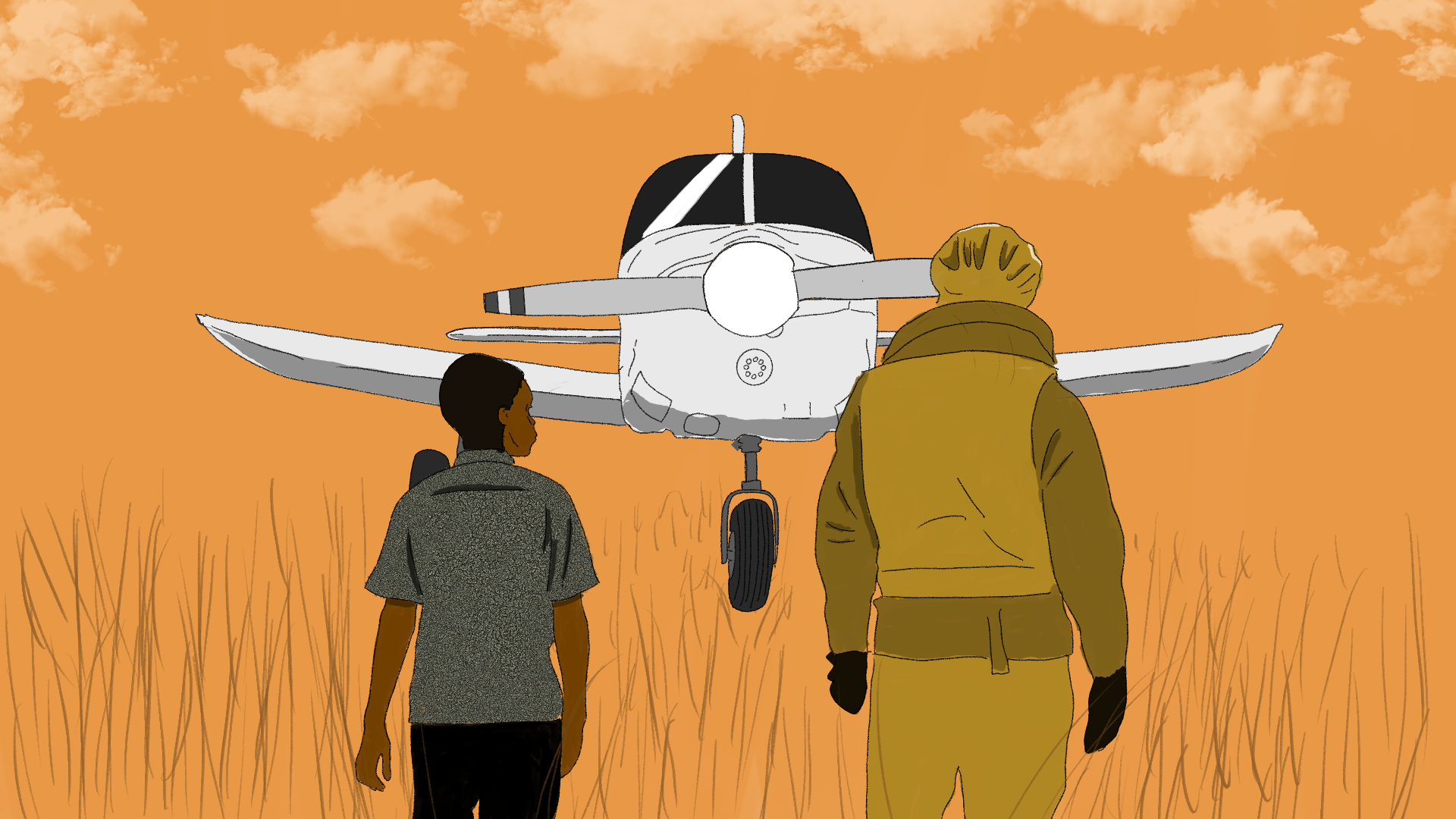
It landed bumpily, then slowly came to a halt in the grassy field that offered a rural runway. To M’Mwenda’s surprise, a man jumped out of the machine, landing squarely on the ground before ripping off a layer of his headgear and carelessly throwing it aside. M’Mwenda watched the man kick the ground several times before finally squatting on his haunches, hands running vigorously through his hair of maize silk. From his vantage point, the man’s frustration was evident. After a while, the strange man rose and moved to the front of the machine, where he opened its nose. M’Mwenda, inexorably drawn to the peculiar machine, inched closer to the unfolding spectacle. The man eventually noticed M’Mwenda and called out to him in a strange mixture of dialects, not quite kiMeru, but M’Mwenda discerned that he was being asked about their location. “Igembe,” he shouted, and when asked where the mission station was, he pointed west towards Kaaga. The man pulled his thick leather gloves off and stuck them into the back of his trousers while explaining, once again in his mutilated dialect, that M’Mwenda should stay and watch his plane and not let anyone near it. The boy nodded solemnly, his excitement mounting at the realisation that he could explore the wondrous machine unchecked.
He watched the man walk away and waited until he was out of sight before edging closer. Slowly, he circled the machine, examining its various components—wheels, wings, and propeller. Its fat body and spindly wings reminded him of the flying termites that rose from the ground when the rains fell, their homing senses drawing them unwittingly towards the homestead fires. Invariably, they would fly in too close and burn their wings in the flames, providing a tasty treat once roasted. Driven by his curiosity and unaware that he was mimicking the alates, M’Mwenda reached out to touch the plane’s nose. The still-hot metal seared his hand, causing him to howl and squeeze the singed appendage between his legs, desperately trying to soothe the burn as he jumped up and down in pain.
M’Mwenda lifted his hand from the cane and turned it over, eyes lingering on the grooves left by the biplane decades earlier. Imprinted for life. It was always pain; this long-running twisted affair between him and the world of machines of the sky. The first encounter should have warned him. But how was he to know that it was not to be an isolated incident? His fascination with machinery was cemented that day, and as soon as his younger brother was old enough to tend the goats by himself, M’Mwenda sought a machine apprenticeship. Providence brought him into the orbit of Manga Khan, a Punjabi who ran a mill and the only garage services between Maua and Fort Hall. For fifteen years, M’Mwenda honed his craft, his ears becoming attuned to the whims of a misfiring engine, while his fingers would coax life out of inanimate devices, making them purposeful once again. In time, he became the unofficial head of all mechanical services housed under Khan’s growing enterprise and baptised ‘the magical hands of Meru’. For M’Mwenda, life was simple and gratifying in its evolution. During the day, he would spend hours unlocking the mysteries of mechanical contraptions, while his evenings were devoted to listening to tales from his daughter Gakenia. At only eleven, her aptitude and inquisitiveness had earned her a place in intermediate school. Like M’Mwenda, she thirsted for understanding, even if her curiosity would often be mistaken for insolence within the walls of the District Education Board classroom.
His work meant he would occasionally be dispatched to Nairobi to search for spare parts for machines that had broken down all over the region and had found their way to the workshop in Meru. The end of April was always a tricky time to travel. The seasonal long, heavy rains rendered lorries stuck in muddy tracks on the roads from the highlands to the capital. A simple four-hour journey would often take a whole day. It was no different this year. When M’Mwenda arrived in Nairobi after a gruelling seventeen-hour journey, he was exhausted. This trip to Nairobi in 1954 is what brought him his second encounter with pain.
M’Mwenda thought he would only be in Nairobi for a few days, waiting for the delivery from the port in Mombasa, but the goods train had broken down on account of the heavy rains. The mood in the capital was grim. Whispered accounts of Mau Mau collaborators disappearing daily were spread in hushed tones across eateries and bars that dotted the African estates. Life was markedly different from Meru, where such stories were received as news clips, distant reports of the happenings from the capital. Here it seeped into daily life. Nairobi was dotted with checkpoints where Africans were required to present their kipande with the requisite stamp authorising them to be in the capital. The curfew that curtailed movement from dusk to dawn was a constant reminder of unusual times. By the end of the week, he was reluctant to spend yet another day hanging around the social halls of Bahati Estate, where his fellow machine enthusiast Wanjau had offered him a place to stay. After another futile trip to the train station, M’Mwenda decided to walk to the Nairobi Aerodrome. Knowing full well he would not be allowed in without a work pass, he secured a viewing spot outside the fence where he could watch the planes. Lying on the grass, he settled into a comfortable position to enjoy watching the small planes take off and land from the single murram runway.
The following morning, he rose early and made his way to the water stand in the courtyard at the back of Wanjau’s house for his morning ablutions. The dawn rays had just begun to light up the sky as M’Mwenda undressed and folded his clothes into a neat pile. He was standing in his underpants, cupped hands full of tepid water to wash his torso, when the sirens started blaring. The wash area at the centre of the small houses burst into a flurry of activity as men in singlets and women still wrapping shukas around their bodies poured out of the tiny homes and into the small, open wet area. M’Mwenda was confused, wondering whether this was a regular occurrence, a drill perhaps, but the petrified looks on the faces of the block residents suggested otherwise. He reached for his shirt, pulling it onto his still wet body as he scrambled back inside the house to try and find his shoes. Wanjau was struggling to light a fire, hurriedly throwing papers into it, fanning it, and then fuelling it with sheaves of pamphlets. M’Mwenda didn’t pause; instead, he scrambled around looking desperately for his kipande, the government pass that conferred legitimacy to every African in their homeland. He was still searching when the door was knocked down, and two askaris marched inside, shoving batons in their faces, screaming for the two men to get out.
Dazed, he stumbled outside, his hands held above his head. He was faced with an armada of land rovers, lorries, and loyalists. All along, the bullhorn blared repeatedly, commanding everybody to exit the houses. He stumbled towards a group of residents, women in tears and men trying hard to rein in their anger and helplessness, faces stoic yet wary. Sjamboks rained down on the hapless residents who were forced to squat and await direction or, worse, judgment. M’Mwenda looked at Wanjau, but his friend refused to meet the mechanic’s gaze, perhaps all too aware of the question in his eyes. Noise from the ransacking of houses pealed through the estate. M’Mwenda watched one askari come out of Wanjau’s house holding charred pieces of paper, remnants of pamphlets, half-burnt. The askari who had chased them from the house scanned the crowd before his eyes settled on Wanjau. He strode over to him and hoisted him to his feet. M’Mwenda recoiled in horror when hands reached out to yank him up as well. The two men were separated from the crowd and flung into a smaller group. Operation Anvil was just getting started.
By noon, all the residents of Bahati, Ziwani, and Makongeni had been flushed out of their homes, assumed guilty of insurgency, of collaboration, or of just plain insolence. Forty-eight hours after the dawn raid, more than 50,000 people had been forcibly removed from their homes, beaten, questioned, and detained.
On the march from Bahati to the detention site at Langata, he passed the aerodrome. Once again, he watched the planes take off one after another, heading to the native reserves to drop pamphlets that urged residents to denounce collaborators. This time, M’Mwenda’s pain would be long and sustained. On the first day at the camp, the manacles of his accursed timing became clear. During his first round of screening at Langata camp, the lack of a kipande branded him as questionable. By the second round, weeks later, he had been judged a courier of the rebel movement between Nairobi and Meru. M’Mwenda was labelled ‘Black’ and sentenced to the camps for interrogation and hard labour. If the degrading conditions of the labour camp at Embakasi were not enough to crush a man’s spirit, months of back-breaking toil of quarrying and ferrying ballast in the Lukenya Hills were more than enough to shatter a man’s frame. In time, it dawned on M’Mwende that more men arrived each morning than departed each evening. The labour camps collected their tolls, and the bodies of broken men were bequeathed daily to the earth they were condemned to quarry.
M’Mwenda’s mind remained fixed on the only things that could keep him from going mad. He ached to see Gakenia’s dimpled smile and wondered whether his wife, Kagwiria, had given him up for dead, for who goes one day to Nairobi and simply doesn’t return? He had thought of sending her a letter to let her know he had not abandoned her, but decided against it. A message meant to offer hope might demand too high a price, for social ostracisation of suspected Mau Mau sympathisers was much worse than the emotional pain of widowhood. As a widow, sympathy and care would flow from the community, whereas kindness to a collaborator’s wife was as good as placing a target on one’s back.
These were thoughts that tormented him as he pushed through endless days of hard labour building a road to nowhere. Perhaps the thoughts of his family were what caused him to lose his balance on his way down from the quarry that day in 1957. The massive rock he had balanced precariously on the sackcloth on his shoulder slipped and fell onto his leg before landing on his foot. He screamed and reached for his foot, which remained firmly wedged under the stone. Fellow detainees scrambled around him, moving together to roll the rock off his leg. M’Mwenda lost most of the use of his left foot that day. All that remained after a makeshift procedure that hovered between first aid and assembly line was a mutilated stump of flesh and bone that offered little in the way of stability. His recovery took weeks, downtime he was grateful for even as he screamed through debilitating pain and fear that the camp “doctor” would one day decide to take the remains of his lower leg off altogether. Once he gained enough strength for a modicum of mobility, he sought to make himself useful, afraid that the cruelty that governed the camps would see him sent back to the worksite. Fixing lighting, loose wiring, typewriters, or water pumps, he shambled from one project to another. Within a year, he was considered a reformed ‘black’ and promoted up the pipeline to Mbeu Rehabilitation Camp.
While strict, Mbeu had a much lighter routine, offering M’Mwenda a glimmer of respite after the horrors of Embakasi. The daily work schedule of planting and harvesting would be finished by mid-afternoon before a final session focused on stuffing as much anti-Mau Mau propaganda into detainee heads broke the workday. As the detainees chanted the pro-colonial verses with vigour, it was presumed that thoughts of collaboration and independence were erased from the depths of their consciousness. For M’Mwenda, who had lived a simple life in search of nothing but purpose for his hands and joy for his heart, the years in detention exposed him to new ideas, to men willing to die for freedom, and to brutality on a scale that he had never thought imaginable. His mind repeatedly returned to one question: what was this idea of a Kenya that was so powerful that one side was determined to relinquish, and the other could not imagine a future where they were not finally in control of it? He continued to try to make sense of the never-ending tug-of-war right up to an ordinary day in 1959, when the British camp commander did the inconceivable and abruptly told everyone to pack up and go home. The Emergency, with its terror, was over.
As Gakenia walked back from the counter, her father watched the women fret around her with amusement. His daughter was going far beyond what he ever had, in deed, in wisdom, and in distance. She was going to find a place in the world where her curiosity and inquisitive mind could carve out a path to her future. As he stood from the chair and hobbled towards Gakenia, his foot dragged behind him. The one mangled in the process of building a road to nowhere now throbbed in pain, a visceral reaction to returning to the site of its demise. The one sacrificed to welcome the mother of an English queen who never left Britannia to inaugurate the glorious Embakasi civil works purchased with the blood of thousands of African men, now forgotten, forever unnamed, wasted bodies dead and buried under a smooth layer of tarmac, eerily lit up night after night by landing lights of aircraft on approach. M’Mwenda looked up at Gakenia’s smile and thought of the road to nowhere anew, a runway of promise for the queen of his heart. Memoried pain, now a road to emancipation.
“Let me assure you that no single group that arrived at Embakasi left with the same number; many of them had to die; that was the order of the place… The work and the beatings at Embakasi were incomparable to anything I had witnessed before or ever since.”
Hunja Njuki, Former Detainee Embakasi Mau Mau Prison
Britain’s Gulag: The Brutal End of Empire in Kenya
mwĩhaki k.m has been published in the Kalahari Review; was longlisted for the Commonwealth Short Story Prize in 2022; was shortlisted for the Afritondo Short Story Prize in 2024, and subsequently published in the anthology Travelling Men Don’t Die. She is based in her hometown of Nairobi, where she plays house with her husband and three offspring, bringing her own African story to life. She is working on her first collection of historical fiction short stories, inspired by her work at Paukwa and her windows into Kenya’s past.
Cover credit: Ebumnobichukwu Agu.